Website Copywriting: How to Write Pages That Convert
How to write website copy that converts: page-by-page structures, before-and-after examples, trust signals and accurate claims for Singapore businesses.
Website copywriting is the writing on your website's main pages, such as the homepage, service pages, about page and contact page, whose job is to help the right visitor understand what you offer, trust you, and take the next step. Good website copy is specific, written in your customers' words, backed by proof, and clear about what to do next. It is not about clever slogans. For a Singapore service business, that usually means saying exactly what you do and where, answering the questions people ask before they buy, showing real evidence such as reviews, licences and past work, and making it easy to WhatsApp, call or enquire. Use your brand guidelines to keep the tone consistent when more than one person writes or edits the site.
This guide gives you a page-by-page structure, before-and-after examples, and the rules to keep your claims accurate. It is written for owners and marketing leads who are writing their own copy or briefing a writer.
In short
- Research before you write: collect the words customers use, the questions they ask and the doubts that stop them buying.
- The homepage's first screen should say what you do, for whom, and what to do next, in under ten seconds of reading.
- Service pages win or lose the sale. Answer price, process, timing and proof on the page.
- Write clearly for people first. Google says there are no special optimisations needed to appear in its AI features beyond good SEO basics.
- In Singapore, advertising is expected to be legal, decent, honest and truthful, and quality claims should be backed by evidence. Use only real reviews and figures you can prove.
What website copywriting is (and how it differs from blogging)
Website copy and blog content do different jobs:
| Website copy | Blog content | |
|---|---|---|
| Pages | Homepage, service, product, about, contact, landing pages | Articles, guides, news |
| Main job | Persuade and convert: enquiries, bookings, sales | Inform and attract: answer questions, build trust over time |
| Reader's stage | Comparing options or ready to act | Researching a problem |
| Length | As short as possible while answering buying questions | As long as the topic needs |
| Changes | Updated when offers, prices or proof change | Published regularly, refreshed when out of date |
Both matter. Blog posts bring people in; the main website pages decide whether they get in touch. If you want help with the other side, see our guide to blog writing services in Singapore.
Research first: customer words, objections and proof
Most weak website copy is written from the business's point of view ("We are a leading provider of innovative solutions") rather than the customer's ("Aircon leaking? We can usually come the same week"). Before writing a word, gather:
- Customer language. Read your Google reviews, WhatsApp chats and enquiry emails. Note the exact words people use to describe their problem.
- Common questions. List the ten questions your team answers most often: price, timing, area covered, what is included, warranty, payment.
- Objections. What makes people hesitate? Price, trust, past bad experiences with others, uncertainty about the process.
- Proof. Reviews, project photos, licences and registrations, warranties, years in business, client logos you have permission to use.
- Competitors' pages. Note what they all say, so you can say something more specific.
Put this in one document. It becomes the raw material for every page.
Homepage copy: the first screen and what follows
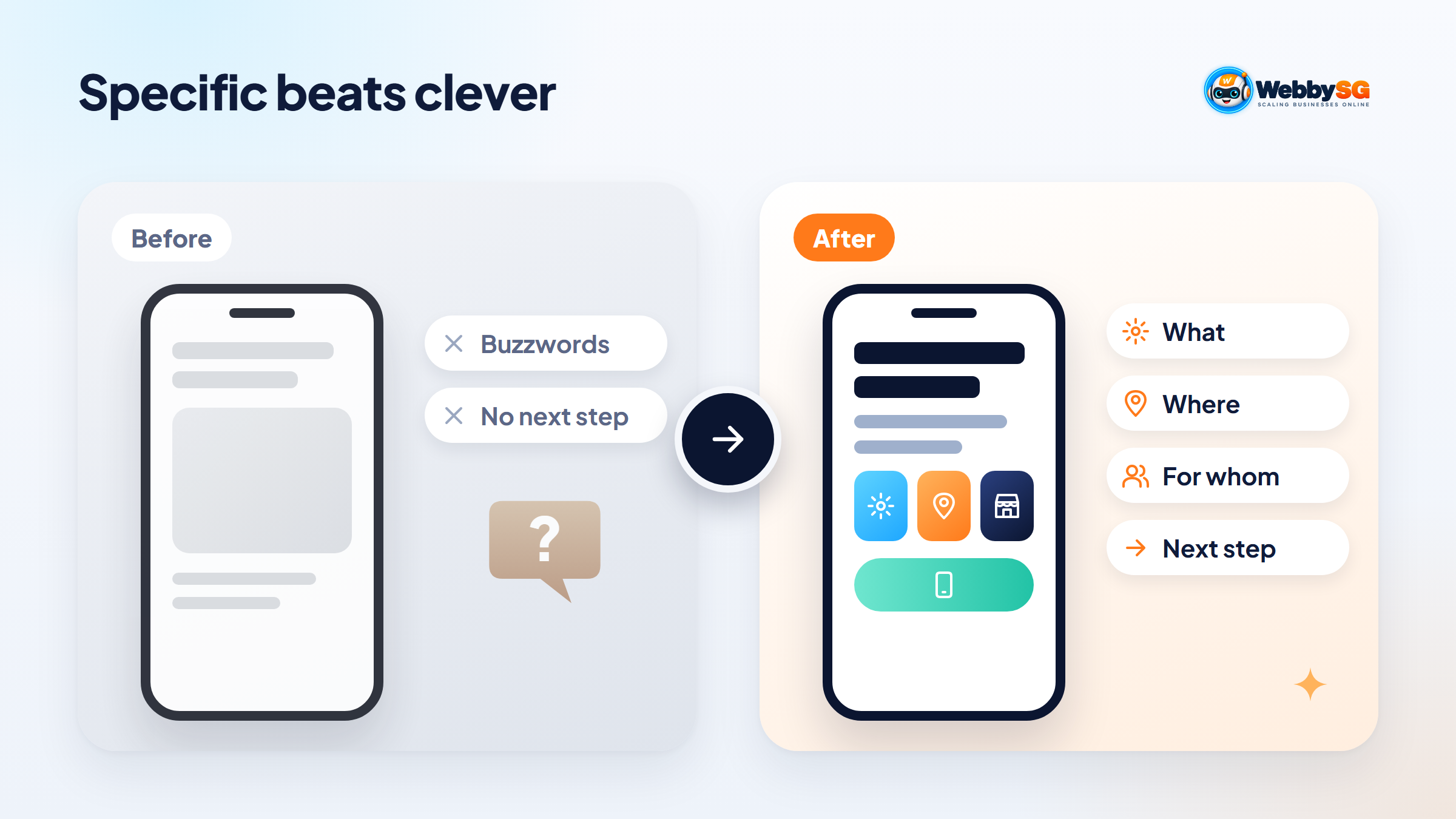
The first screen of your homepage, on a phone, needs to answer three questions straight away: what do you do, is it for me, and what should I do next?
Before and after
Before: "Your trusted partner for excellence. We deliver innovative solutions tailored to your needs."
After: "Aircon servicing and repair across Singapore. Chemical wash, gas top-up and leak repairs for HDB, condo and landed homes. WhatsApp us for a quote."
The "after" version is an illustration, but notice what changed: the service, the area, the types of home and the next step are all clear in two lines.
Below the first screen, a homepage usually works in this order:
- Services, each with one line and a link to its own page
- Proof: reviews, project photos, licences or client logos
- How it works: three or four steps from enquiry to completion
- Why choose you: specific differences, not adjectives
- Answers to common questions
- A clear final call to action with WhatsApp, phone and form options
Service page copy that answers buying questions
Service pages are where people decide. Give each main service its own page, and use a structure like this:
- Headline naming the service and location, such as "Office renovation in Singapore".
- Who it is for and the problem it solves, in the customer's words.
- What is included, as a short list.
- Price guidance. A starting price, a range or the factors that affect cost. Even "most projects fall between X and Y" is better than silence, as long as it is true.
- Process and timing, step by step.
- Proof specific to this service: a project, a review, a certification.
- Questions and answers covering the objections you collected.
- Call to action, repeated after key sections.
Before and after
Before: "We offer comprehensive cleaning services of the highest quality."
After: "Move-out cleaning for HDB and condo units. Our team of three cleans a typical 4-room flat in one day, including kitchen degreasing and window tracks. Prices depend on unit size and condition; send us your unit type for a fixed quote."
Again an illustration: the specifics (unit types, team size, what is included, how pricing works) do the persuading. Only write numbers you can stand behind.
About and contact pages that build trust
People read the about page to find out who they are dealing with. Make it about the customer's concerns, not a company history:
- Who runs the business, with real names and photos
- How long you have been operating and what you specialise in
- Registrations and licences relevant to your trade, and your UEN
- How you work and what customers can expect
- Selected reviews or projects
On the contact page, list every way to reach you (WhatsApp, phone, form, email), your business hours, your address if customers visit, and how quickly you reply. Tell people what happens after they get in touch. For what else a business site needs, see our guide to essential corporate website pages.
Website copywriting for search and AI answers without keyword stuffing
Search engines and AI assistants both look for pages that clearly answer a question. Google's guidance on creating helpful, people-first content asks whether your content provides original information and whether it was created mainly for people or to attract search visits. Its page on AI features and your website says there are no additional requirements or special optimisations needed to appear in AI Overviews or AI Mode beyond being indexed and following SEO fundamentals.
In practice, copy that works for search and AI answers:
- Answers directly. Put a clear one or two sentence answer under each question-style heading, then add detail.
- Names things plainly. Use the words people search for ("aircon chemical wash") alongside your brand terms, once or twice, where they fit naturally.
- Is specific. Areas served, service types, what is included, typical timelines. Vague copy gives an AI assistant nothing to quote.
- Keeps key content as text, not inside images or sliders.
- Uses one topic per page, so each service page clearly owns its subject.
Our explainer on answer engine optimisation goes deeper into how AI tools choose which sources to cite.
Claims, reviews and trust signals: staying accurate
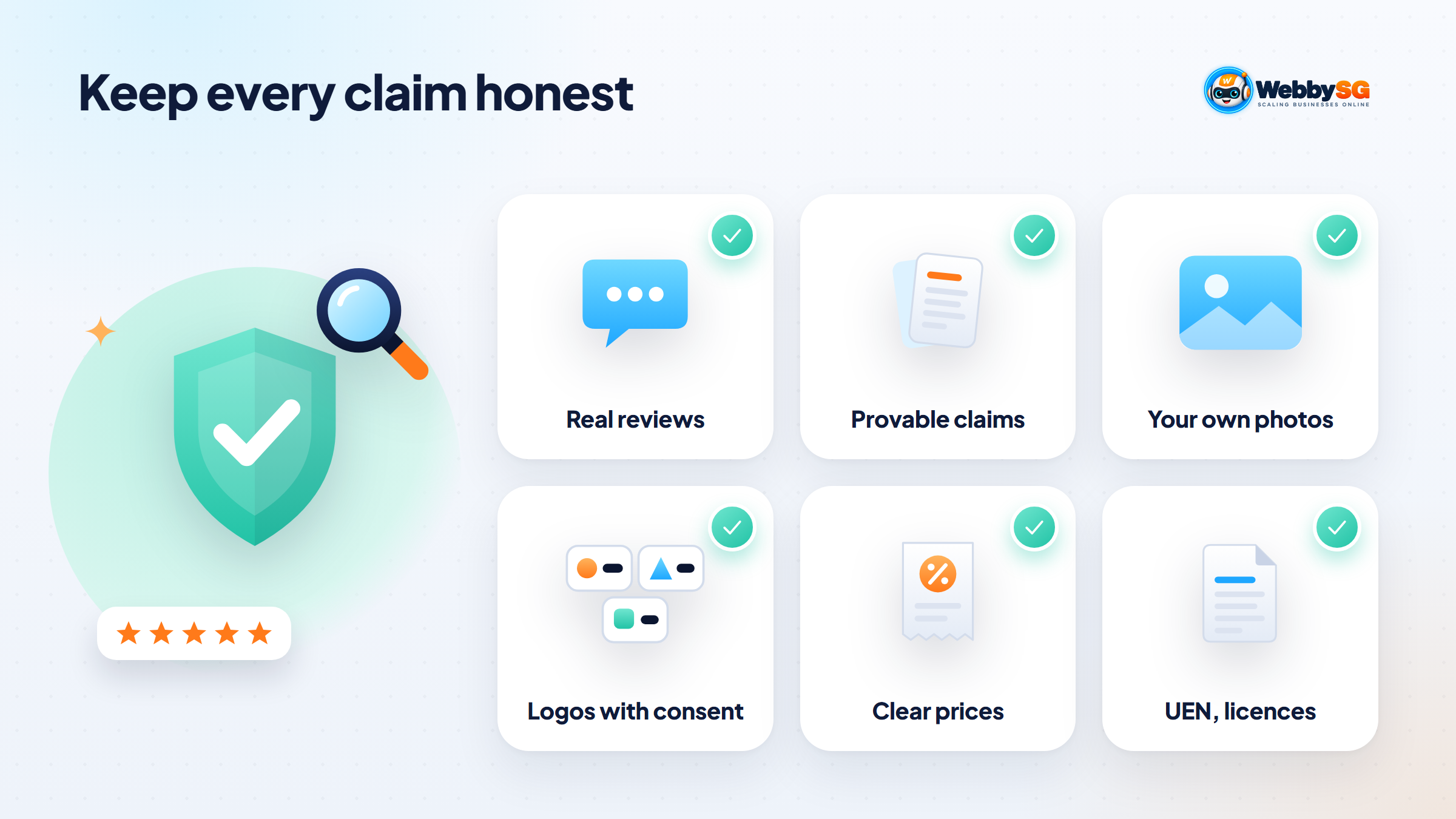
Persuasive copy must still be true. In Singapore, the Advertising Standards Authority of Singapore's Singapore Code of Advertising Practice starts from the premise that all advertisements should be legal, decent, honest and truthful. The Competition and Consumer Commission of Singapore (CCS) also issued a guide on quality-related claims in October 2025, which asks businesses to make claims that are true, clear and meaningful, and to substantiate them with credible evidence.
A simple checklist for your copy:
- "Best", "No. 1", "cheapest": only if you can prove it, and say on what basis.
- Numbers: years in business, projects completed, response times. Use real figures you can show if asked.
- Reviews and testimonials: real customers only, with permission, and do not edit them to change their meaning. Never write fake or AI-generated testimonials.
- Before-and-after photos: your own work, not stock images presented as yours.
- Client logos: only with the client's permission.
- Prices: state what is included and any conditions. If you are GST-registered, show GST-inclusive prices.
- Comparisons with competitors: fair and backed by evidence.
Specific, verifiable details such as your UEN, relevant licences, a physical address and recent reviews are also the trust signals customers look for. This is general information, not legal advice.
DIY, AI-assisted or hire a copywriter?
| Option | Suits you if | Watch out for |
|---|---|---|
| DIY | You know your customers well and have time to research and edit | Writing about yourself instead of the customer; too close to see what is unclear |
| AI-assisted | You use AI for outlines, variations and editing, with your own research and facts | Generic copy that sounds like every competitor; invented facts, figures or reviews |
| Copywriter | Key pages that drive enquiries, a redesign, or a new offer | Briefing poorly; a writer can only be as specific as the information you give |
Whichever you choose, the research document from earlier is what makes the copy specific. AI tools can speed up drafting, but Google's guidance warns against using automation mainly to manipulate rankings, and an AI tool does not know your prices, process or customers unless you tell it.
What to hand a copywriter
If you hire someone, the brief decides the result more than the writer's talent does. Give them:
- The research document: customer phrases, top questions, objections and proof.
- A list of pages, with the one action you want from each (WhatsApp, call, quote request).
- Real numbers they may use: years operating, price ranges, turnaround times, warranty terms.
- Reviews and project details you have permission to quote.
- Two or three competitor pages, with a note on what you do differently.
- Words and claims to avoid, such as "cheapest" if you cannot prove it.
Ask for one key page first, usually your main service page, and agree on tone before the rest are written. It saves a round of rewrites across the whole site.
If you are planning a new site or a redesign, our web design service plans the copy structure alongside the design, so each page has a clear job. If you would like a second opinion on your current pages, get in touch.
Frequently asked questions
How long should website copy be?
As long as it needs to be to answer the visitor's buying questions, and no longer. A homepage might be a few hundred words across short sections, while a service page for a considered purchase, such as renovation or B2B services, often needs more to cover price, process, proof and common questions. Cut anything that does not help the reader decide.
Can I use AI to write my website copy?
Yes, as an assistant rather than the author. AI is useful for outlines, alternative headlines and tightening drafts. You still need to supply the specifics, check every fact, and make sure the result sounds like your business. Never let it invent reviews, figures or credentials.
How much does website copywriting cost?
It varies widely with the number of pages, the research involved, the writer's experience and whether SEO is included. Ask for quotes per page or per project, and check whether research, revisions and SEO are included. A smaller number of well-researched key pages is usually better value than many thin ones.
How often should I update website copy?
Review key pages at least once or twice a year, and update them whenever your services, prices, team or proof change. Add new reviews and projects as they come in. Outdated prices or services cost you trust and waste enquiries.
What is the difference between copywriting and content writing?
Copywriting aims to persuade someone to act, such as enquire, book or buy, and is used on website pages, ads and emails. Content writing aims to inform and build trust over time, such as blog articles and guides. Most businesses need both, with copy on the pages that convert and content that brings people to the site.