B2B Website Design: What Business Buyers Need
How to design a B2B website that works for buyers, finance and procurement: clear positioning, proof, enquiry forms that qualify leads, and key pages.
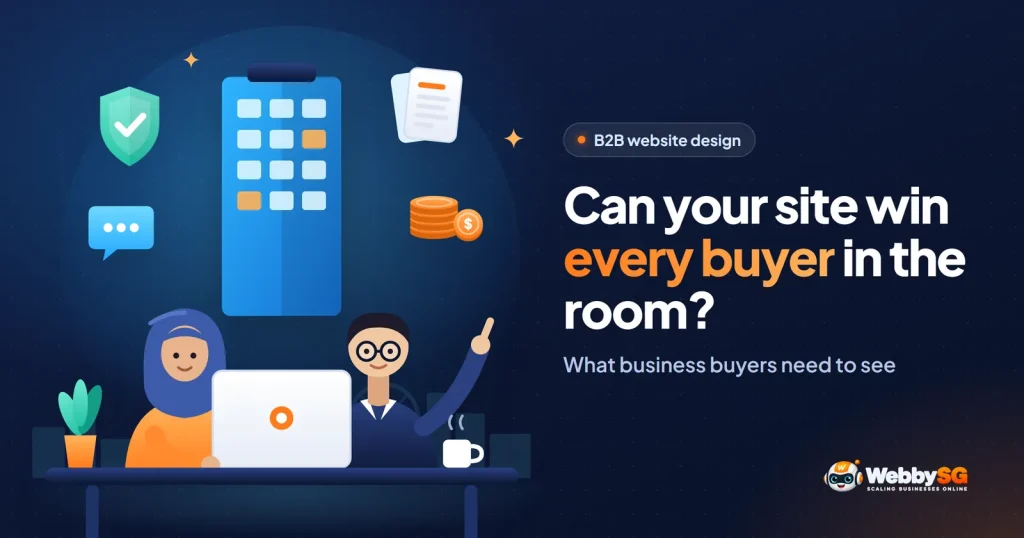
B2B website design is the planning and design of a website for a business that sells to other businesses, where the goal is qualified enquiries rather than instant sales. A good B2B site tells the right buyer within seconds what you do and for whom, then gives each person involved in the decision the proof and documents they need before they ask for a quote or a meeting. For a Singapore SME, that usually means clear service pages, case studies, visible credentials such as your registered name, UEN and certifications, and an enquiry form that asks the right questions.
This guide is for owners of Singapore companies selling to other businesses, from industrial suppliers and IT providers to facilities, logistics and professional services firms.
In short
- B2B purchases involve several people, take longer and are researched quietly before anyone contacts you. Design for that research.
- Give each role what it looks for: users want capability, finance wants value and terms, procurement wants credentials and documents.
- Proof beats claims. Specific case studies, certifications and named sectors persuade more than "trusted by leading companies".
- Enquiry and request-for-quotation (RFQ) forms should collect enough to qualify a lead without putting buyers off.
- Measure success in qualified leads and pipeline, not visits.
Why B2B website design starts with how businesses buy
A consumer buying a pair of shoes decides alone, often in minutes. A company buying a cleaning contract, a software system or industrial parts behaves differently, and a B2B website has to reflect that.
| Factor | B2C website | B2B website |
|---|---|---|
| Decision-makers | Usually one person | Several people: users, managers, finance, procurement |
| Decision time | Minutes to days | Weeks to months, often with a formal quotation process |
| Main action | Buy now | Request a quote, book a meeting, download a capability statement |
| What persuades | Price, reviews, convenience | Relevant experience, reliability, credentials, total cost |
| Return visits | Fewer | Many, by different people from the same company |
The practical consequence: your website will be visited several times by people you never hear from, and judged before the first call. Each visit has to answer a different person's questions.
Design for the buying committee: users, finance, procurement
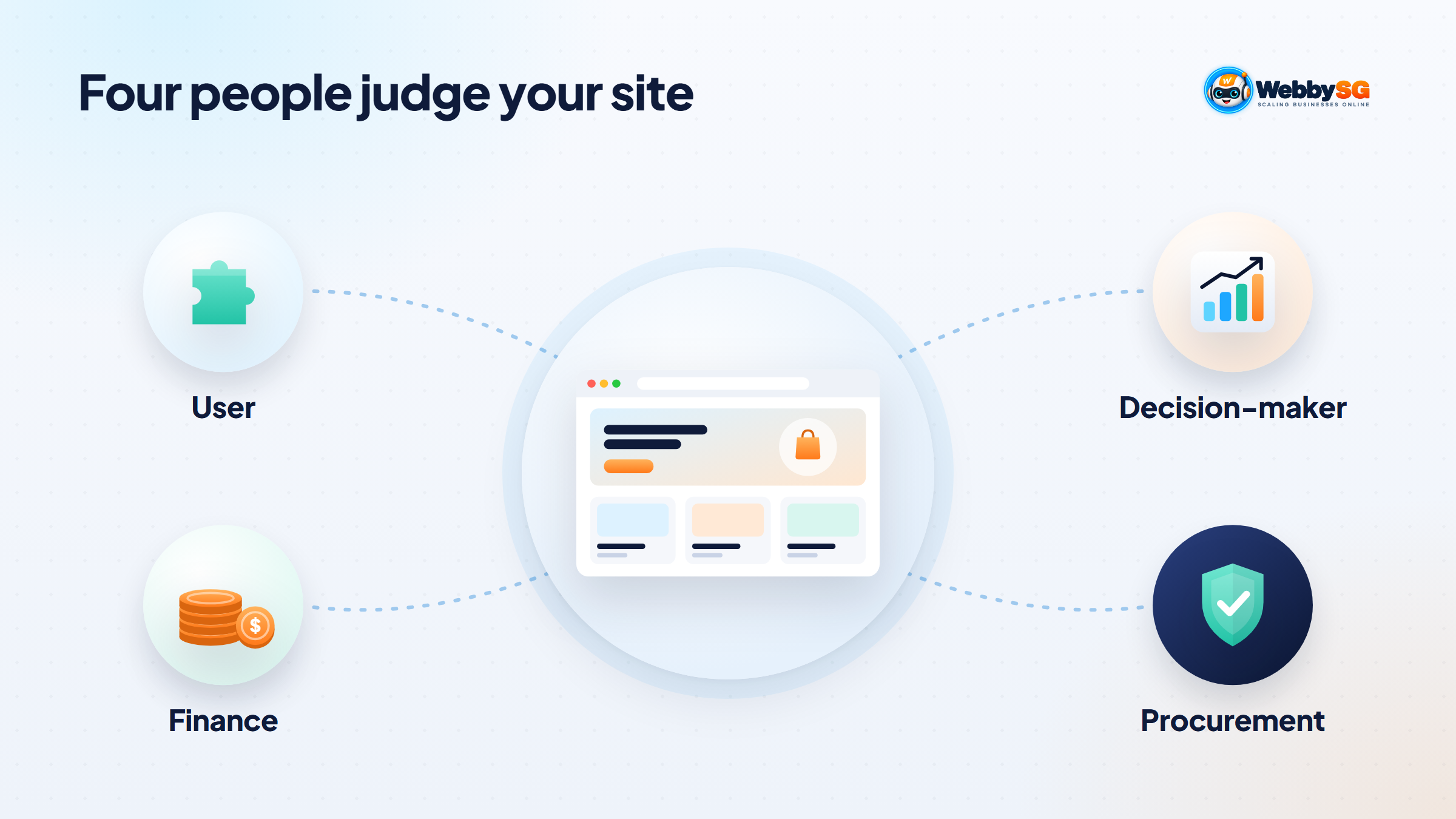
Think of a typical purchase by a Singapore company. An operations manager finds you and shortlists you. A director approves the budget. A finance or procurement officer checks your company details and terms. Each one visits a different part of your site.
| Role | What they want to know | Pages and content that help |
|---|---|---|
| User or specialist | Can you solve our problem? Have you done it before? | Service pages with specifics, case studies, technical details, FAQs |
| Decision-maker | Is this worth it? Is the supplier reliable? | Outcomes, client sectors, team experience, process overview |
| Finance | What will it cost overall? What are the terms? | Pricing approach or ranges, what is included, payment terms |
| Procurement | Is this a legitimate, compliant supplier? | Company details, UEN, certifications, policies, capability statement |
A useful check: for each of your main services, can someone in each of these roles find their answer within two clicks? If not, the gap is usually missing content rather than design.
Positioning: say what you do and for whom in five seconds
Many B2B homepages open with lines like "Your trusted partner for innovative solutions". A buyer arriving from Google cannot tell what you sell. Swap the vague headline for one that names the service and the customer, and if you can, the result.
- Vague: "Excellence in integrated solutions."
- Clear: "Commercial cleaning and facilities support for offices and warehouses in Singapore, with daily, weekly and project-based contracts."
Below the headline, show the sectors you serve, two or three reasons buyers choose you, and one clear action such as "Request a quote". Google's guidance on creating helpful, people-first content makes the same point from a search angle: content should clearly serve the reader and demonstrate first-hand expertise. Specific service pages written for a defined audience do both.
Proof that persuades: case studies, logos, certifications
B2B buyers are cautious because a bad supplier choice reflects on them. Proof reduces that risk. The most persuasive forms, roughly in order:
- Case studies with the client's sector, the problem, what you did, and a measurable or observable result. Use client names only with permission; a description such as "a regional logistics company" still works.
- Certifications and memberships relevant to your industry, such as ISO certifications or bizSAFE, shown with the scope and level you actually hold.
- Client logos, again only with permission, grouped by sector.
- Testimonials with a name, role and company where the client agrees.
- Process and team details: who will work on the account and how projects run.
Never invent or exaggerate proof. Procurement teams check, and a single unverifiable claim can undermine everything else on the page.
Enquiry and RFQ forms that qualify leads
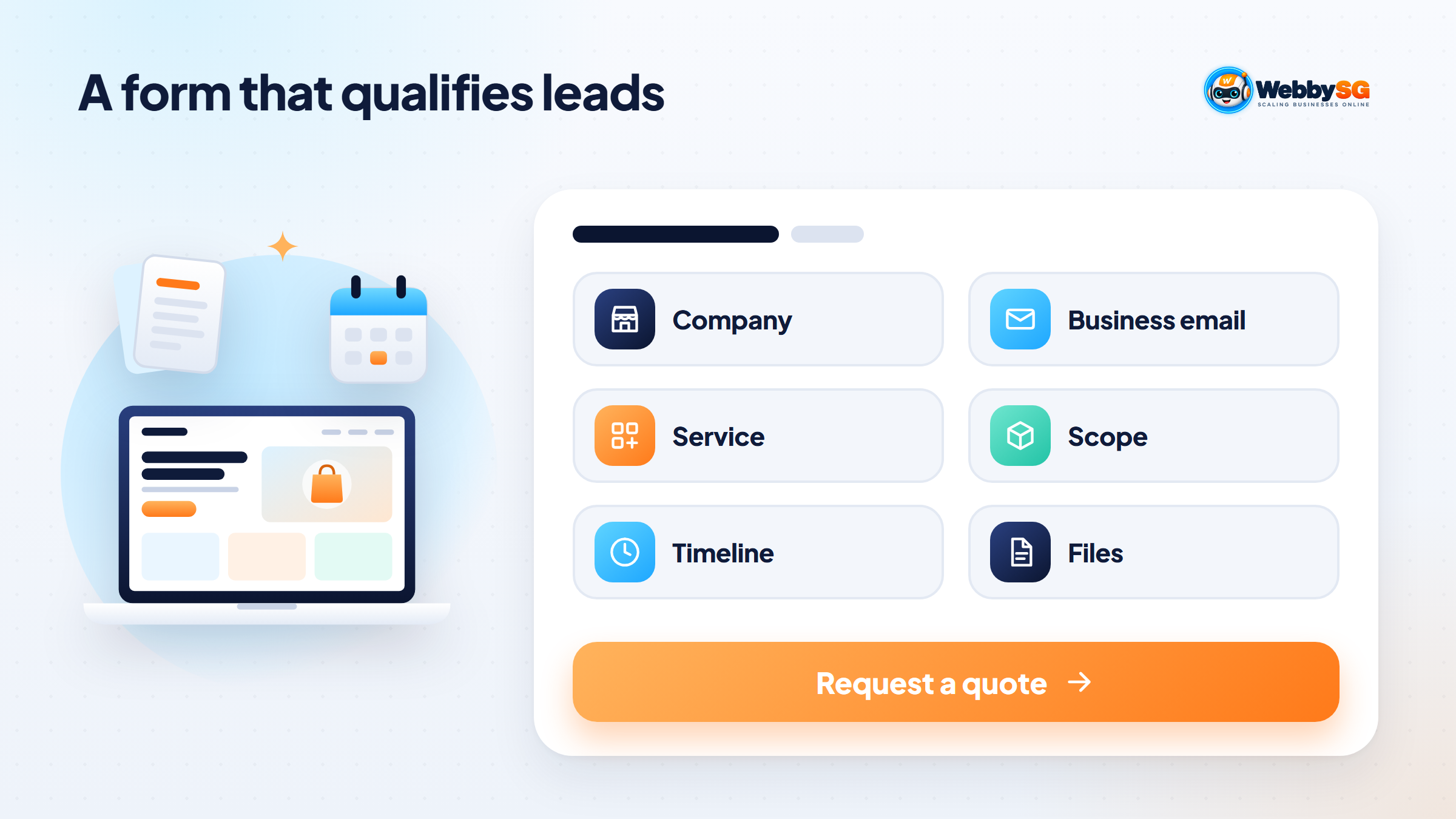
The enquiry form is where a B2B website earns its keep. Too short, and you get vague enquiries you cannot price. Too long, and serious buyers leave. A practical middle ground for most SMEs:
- Name, company name and business email
- Phone or WhatsApp number
- Service needed (a dropdown matching your service pages)
- Scope, quantity or site size (one short field)
- Timeline (for example: within a month, one to three months, just researching)
- File upload for specifications, drawings or tender documents (optional)
- Message
If the quote depends on detailed specifications, offer a separate RFQ form for buyers who are ready, and keep a short "talk to us" form for everyone else. Send an automatic reply confirming what happens next and when.
On personal data, Singapore's PDPA generally does not apply to business contact information, such as a work email or job title, when it is provided for business purposes. Many B2B forms still collect personal mobile numbers or are used for marketing, so it is sensible to include a short notice explaining how you use the data, link your privacy policy, and keep marketing consent separate. The PDPC sets out the data protection obligations that apply to personal data. This is general information, not legal advice.
Pages procurement teams look for
Procurement and finance officers often visit after the specialist has shortlisted you. They are checking that you are a real, established and compliant company. Make it easy for them:
- Company details: registered company name and UEN in the footer and on the contact page, along with your business address.
- About page: years in operation, team size or key people, and the sectors you serve.
- Certifications: current certificates and their scope.
- Capability statement: a downloadable PDF summarising services, experience, credentials and contact details.
- Policies: privacy policy, and where relevant, quality, safety or sustainability policies.
- Government work: if you supply the public sector, say so. Public-sector quotations and tenders in Singapore are published on GeBIZ, where local companies with a UEN log in with Corppass to find opportunities and submit bids.
Our guide to essential corporate website pages covers these pages in more detail.
Pricing pages: show, range or hide?
Many B2B companies hide prices because every job is different. That is understandable, but buyers often shortlist suppliers who give them some sense of cost. There are three options:
| Approach | Works for | Trade-off |
|---|---|---|
| Show fixed prices or packages | Standardised services, subscriptions, products | Competitors see your prices; harder to adjust per client |
| Show ranges or "from" prices | Most project-based services | Needs a clear explanation of what changes the price |
| No prices, explain what affects cost | Highly custom work, large contracts | Some buyers leave; enquiries need more qualifying |
Even if you do not publish numbers, a page explaining what affects the price and what a quotation includes saves time for both sides. If you are GST-registered and show prices, show them inclusive of GST, as IRAS requires for prices displayed to customers.
A B2B website page plan for a Singapore SME
Most SME suppliers do not need a 60-page site. Something around 12 to 20 pages covers the buying committee if each page has a clear job. As an illustrative example, here is how a facilities services company with three core services might lay it out:
| Page | Main reader | What it must contain |
|---|---|---|
| Homepage | Everyone | What you do, for which sectors, one primary call to action, a strip of proof |
| One page per core service (3) | Users and specialists | Scope, how the service runs, typical contract types, FAQs, a relevant case study |
| Sector pages (2 to 3, only if the work genuinely differs) | Decision-makers | Sector-specific problems, compliance points and examples |
| Case studies (3 or more) | Decision-makers | Problem, approach, result, client sector |
| About and credentials | Procurement | Years operating, key people, certifications with scope, UEN |
| Pricing or "how we quote" | Finance | Ranges or the factors that drive cost, what a quotation includes |
| Request a quote | Ready buyers | The qualifying form, response time, what happens next |
| Contact, privacy policy, terms | Procurement and finance | Registered name, address, data notice, payment terms |
Start with the service pages and case studies. They do most of the selling, and they are the pages that take longest to write.
Measuring a B2B site: leads, not visits
B2B websites often have modest traffic, and that is fine. What matters is whether the right companies get in touch. Track:
- Enquiry and RFQ submissions, WhatsApp clicks and calls, set up as key events in GA4
- The share of enquiries that are qualified (right size, right service, real timeline)
- Which pages qualified leads visited before enquiring
- Capability statement downloads
- Over time, enquiries that become quotations and contracts
Ask your sales team to note the source of every enquiry for a few months. Combined with analytics, it shows which pages and channels actually produce business. A website UX audit can then show where qualified buyers drop off.
If your current site does not reflect how your buyers decide, our corporate website design service builds B2B sites around service pages, proof and qualifying forms. Our corporate website redesign guide explains how to plan the project, and you are welcome to contact us to talk it through.
Frequently asked questions
Should a B2B website show prices?
Show prices or ranges if your services are reasonably standard, because buyers use them to shortlist. If every job is custom, explain what affects the cost and what a quotation includes instead. Either way, make it easy to request a quote. If you are GST-registered and display prices, show them inclusive of GST.
How many case studies does a B2B site need?
Aim for at least one for each main service or sector you want to win more work in. Three detailed, relevant case studies persuade more than ten vague ones. Add new ones as projects finish, with client permission.
What should a capability statement include?
A one- or two-page summary of your company: registered name and UEN, core services, sectors served, relevant experience, certifications, key people, and contact details. Keep it current and offer it as a PDF download that procurement teams can attach to internal approvals.
Is a B2B website different from a corporate website?
They overlap. A corporate website presents the company as a whole, while a B2B website is built specifically to win business from other companies. Most Singapore SMEs need both in one site: corporate credibility plus service pages, proof and enquiry forms aimed at business buyers.
How long does a B2B website project take?
It depends mainly on the number of pages and how quickly content is ready. Writing service pages, gathering case studies and approving credentials usually takes longer than the design and build. Plan content early and agree who signs off each page.