SEM vs SEO Singapore: Which Should Your Business Fund?
SEM vs SEO in Singapore compared: how paid search and SEO differ in cost, speed and results, when each should come first, and how SMEs can run both together.

If you are weighing SEM vs SEO in Singapore, you are really deciding how you want to pay for search visibility: per click, starting this week, or through steady work on your website that takes months to show and keeps working after you stop paying for it. This guide explains the difference, when each one should come first, and how Singapore SMEs can run both without wasting budget.
SEM (paid search ads such as Google Ads) puts you at the top of Google within days, but you pay per click and the traffic stops when the budget stops. SEO earns unpaid rankings more slowly and keeps working. Start with SEM if you need leads this month; start with SEO if you can wait for lower long-term costs.
What SEM and SEO mean in Singapore
In Singapore, most business owners and agencies use SEM (search engine marketing) to mean paid search: ads bought through Google Ads that appear above or below the normal results with a "Sponsored" label. Strictly speaking, some marketers use SEM as an umbrella for all search marketing, paid and unpaid. This article uses the everyday meaning: SEM is paid search.
SEO (search engine optimisation) is the work that helps your pages rank in the unpaid results: technical fixes, pages written for what buyers search, internal linking, local listings and authority from other sites. Google does not charge for those positions, but earning them takes time and ongoing effort.
Both answer the same moment: someone in Singapore types what they need into Google. The difference is whether you rent the top of the page or build your way onto it.
SEM vs SEO at a glance
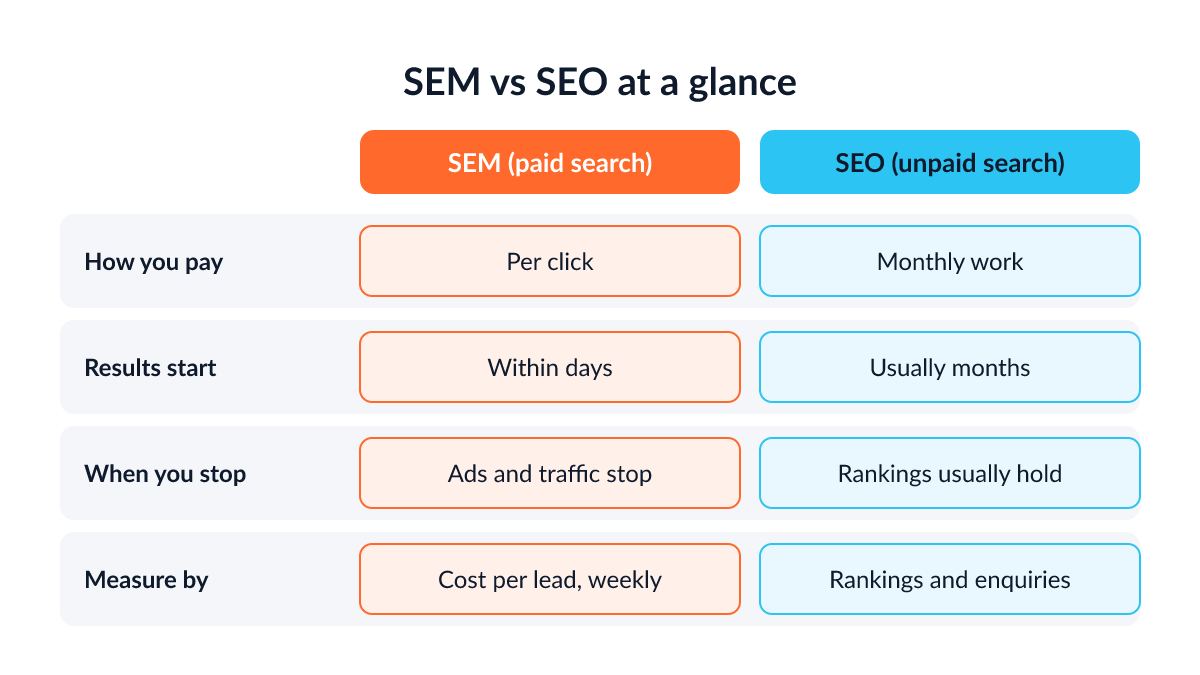
The table below compares the two on the points that usually decide the budget.
| Factor | SEM (paid search) | SEO (unpaid search) |
|---|---|---|
| How you pay | A cost for each click, set by an auction against other advertisers, plus any management fee | Monthly work on the website and its content; no charge per click |
| When results start | Campaigns can go live within days | Usually months; Webby SG tells its SEO clients to expect meaningful movement within three to six months |
| When you stop paying | The ads, and the traffic from them, stop | Rankings usually hold for a while, then fade if competitors keep improving |
| Control | You choose keywords, budget, locations and schedule | You influence rankings but Google decides them |
| What it needs from your site | A landing page that matches the search and converts on mobile | Pages that answer the search well, load fast and are easy for Google to read |
| Best measured by | Cost per lead, week by week | Rankings and enquiries for buying-intent keywords, month by month |
When SEM should come first
Paid search is the better first step when timing matters more than long-term cost. It tends to fit when:
- You need enquiries this month. A new business, a new service line or a slow quarter cannot wait months for rankings.
- Your site has no rankings yet. A new website usually has little search visibility, so ads are the only way onto page one for now.
- The offer is time-bound. A seasonal promotion or an event date is over before SEO would pick it up.
- You want to test keywords before investing in content. A few weeks of ads show which searches actually turn into enquiries.
- One customer is worth a lot. If a single job covers many clicks, paying per click can make sense from day one.
When SEM is the wrong first step: if the click prices in your industry are high compared with what a lead is worth to you, or if your landing page does not convert, ads will spend the budget quickly and prove little. Fix the page first, or start with SEO.
When SEO should come first
SEO is the better foundation when you can wait for results and want each lead to cost less over time. It tends to fit when:
- You cannot sustain paying for every click. SEO costs a fixed monthly amount of work rather than a bill that grows with every visit.
- Buyers research before they choose. Cost, comparison and "how to" questions are easier to win with helpful pages than with ads.
- You serve customers nearby. For "near me" and area searches, local SEO for Singapore businesses puts you in the Google Maps results, which ads alone do not replace.
- Competitors outspend you on ads. You may not win the auction for the most expensive keywords, but a well-built page can still rank beneath the ads.
When SEO is the wrong first step: if the business needs revenue within weeks, or the website is about to be rebuilt, SEO work done now may arrive too late or be undone by the move.
Which to start with: common Singapore scenarios
Most SMEs fit one of these situations. Use it as a starting point, not a rule.
| Your situation | Start with | Why |
|---|---|---|
| New business or new website, nothing ranking yet | SEM, with SEO foundations built alongside | Ads bring the first enquiries while the site earns rankings |
| Local service (clinic, renovation, cleaning) serving nearby areas | Local SEO first, ads for the highest-value services | Maps results and reviews carry much of the local demand |
| B2B service with a long sales cycle | SEO, with small tests on SEM | Buyers read and compare before they enquire |
| Online store with a seasonal sale | SEM for the sale period | The window is too short for SEO to catch |
| Established site sitting on page two for key terms | SEO | Improving pages that already rank is usually cheaper than paying for the same clicks |
Check these before spending on either
Whichever you choose, the same few gaps waste most budgets. Check them first.
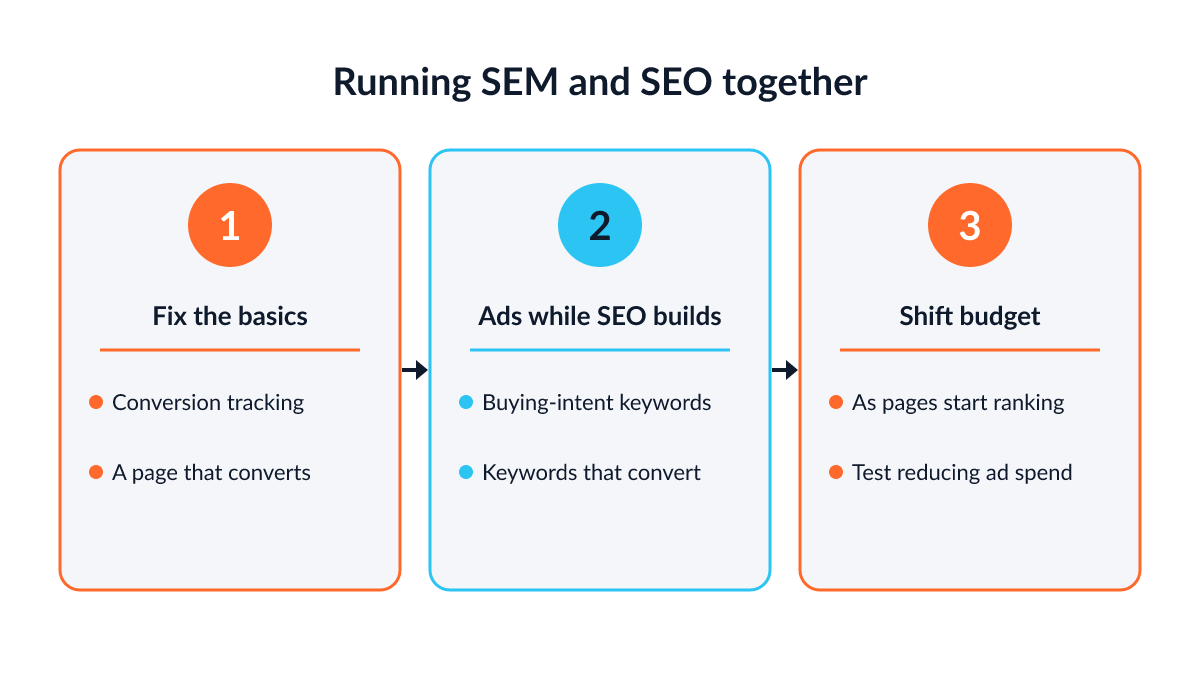
- Conversion tracking. Calls, forms and WhatsApp clicks should be tracked in Google Analytics and Tag Manager before any money is spent, so you judge results by leads rather than clicks.
- A page that converts. Both channels send people to your website. If it loads slowly on a phone or hides the contact options, the traffic is wasted. Our guide to why a website isn't generating leads covers the usual leaks.
- What a lead is worth. Know roughly how much a customer is worth to you, so you can tell whether a cost per lead is acceptable.
- Account ownership. The Google Ads account, Analytics and Search Console should be in your company's name, so the data stays with you whoever manages them.
Running both: how SEM and SEO support each other
For many SMEs the answer is not one or the other but a sequence. Ads cover the months before SEO takes effect, and each channel makes the other more efficient:
- Ads show which keywords convert. The search terms report lists the actual searches that led to enquiries. Those are strong candidates for SEO pages.
- SEO pages can become better landing pages. A page written to answer a search properly often suits ad traffic for the same search too.
- Budget can shift as rankings arrive. Once a page ranks well for a keyword, you can test reducing ad spend on it and move that budget to searches you do not rank for yet.
If you want one team to handle both, Webby SG offers Google Ads management on a flat monthly fee, never a percentage of ad spend, alongside its SEO service, and reports both in the same monthly summary.
How to tell which one is paying off
Compare the two on the same measure: cost per lead. Clicks, impressions and traffic charts are useful signals, but they do not pay invoices.
- SEM: look at spend, leads and cost per lead every week. Expect the first month to be a learning period while negative keywords and bids are refined.
- SEO: look at rankings for buying-intent keywords and enquiries from organic search every month. Judge the trend over several months, not the first few weeks.
- Together: put both in one report for the same period, so you can see where the next dollar does most.
For what monthly SEO should include and how to compare quotes, see what SEO costs in Singapore. As a reference point, Webby SG publishes its monthly SEO pricing at S$500 to S$1,200 a month.
Common mistakes when choosing between SEM and SEO
- Judging SEO in the first month. Rankings take time; cutting SEO early throws away the work already done.
- Sending ads to the homepage. A visitor who searched for one service should land on that service's page.
- Running ads without negative keywords. Without them, the budget pays for searches such as "free", "jobs" or "DIY" that were never going to buy.
- Paying a management fee tied to ad spend. A percentage-of-spend fee rewards spending more, not spending better.
- Switching off ads before SEO is ready. Leads can drop sharply if paid traffic stops before organic rankings are in place.
Frequently asked questions
What is the difference between SEO and SEM?
SEO earns unpaid rankings in Google's normal results by improving your website, its content and its authority. SEM, as the term is usually used in Singapore, is paid search: ads bought through Google Ads that appear with a "Sponsored" label. SEO is slower and keeps working after the effort; SEM is fast and stops when the budget stops.
Which is better, SEO or SEM?
Neither is better for every business. SEM suits businesses that need enquiries quickly, are testing keywords or have a time-bound offer. SEO suits businesses that can wait a few months and want lower long-term costs per lead. Many Singapore SMEs run ads for immediate leads while SEO builds, then shift budget as rankings arrive.
Is SEO still worth it in 2026?
For most businesses whose customers search on Google, yes. Unpaid rankings keep bringing visitors without a charge per click, and well-structured pages can also be quoted in AI answers. It is less suitable if you need results within weeks, or if your website is about to be rebuilt, in which case the work should wait for the new site.
Can I run SEM and SEO at the same time?
Yes, and they work well together. Ads bring enquiries while SEO takes effect, and the ads' search terms report shows which keywords convert, which helps choose SEO targets. As pages start ranking, you can test reducing ad spend on those keywords and move budget to searches you do not rank for yet.
How much budget do I need for Google Ads in Singapore?
It depends on the click prices in your industry and how competitive your keywords are. The budget should be large enough to gather meaningful data in your market before you judge the results. Keep the ad budget separate from any management fee, so you can see exactly how much is going to Google and how much to the people running the account.
SEM vs SEO in Singapore: the short version
SEM buys visibility now and stops when you stop paying; SEO builds visibility slowly and keeps working. If you need leads this month, start with paid search on buying-intent keywords. If you can wait and want each lead to cost less over time, start with SEO. In both cases, fix tracking and your landing pages first, measure both channels by cost per lead, and let what the ads teach you guide where SEO goes next.