
Google Ads Quality Score: What It Is and How to Fix It
What Google Ads Quality Score measures, how to read its three components together, and which fixes to make first on your keywords, ads and landing pages.
Google Ads Quality Score is a 1 to 10 rating that Google shows for each keyword in a Search campaign, summarising how your ads and landing pages compare with other advertisers on the same searches. It is built from three components: expected click-through rate, ad relevance and landing page experience, each rated above average, average or below average. Google describes it as a diagnostic tool, not an input in the ad auction, but it points to the same ad and landing page quality that does affect your Ad Rank and what you pay per click. The practical value is in reading the three components together and fixing the weakest one first.
In short
- Quality Score is a keyword-level diagnostic from 1 to 10. Google states it is not used in the ad auction itself.
- Ad quality in the auction is real: Google says higher quality ads can often lead to lower costs per click and better positions.
- Look at the three component statuses, not just the number. They tell you whether to fix keywords, ad copy or the landing page.
- Fix in order: tighten keyword groups, rewrite ads to match them, then improve the landing page.
- Quality Score only shows for Search keywords with enough exact-match searches. Performance Max and other keywordless campaigns do not show it.
What Google Ads Quality Score is (and what it is not)
Google's Quality Score help page calls it a diagnostic tool that helps you understand how your ad quality compares with other advertisers. The ratings are based on ads shown for the same exact search over the last 90 days, and they are reported per keyword.
Three things trip people up:
- It is not the auction. Google says Quality Score is not an input in the ad auction. Ad Rank is recalculated for every search using auction-time measurements, and Google notes that Quality Score may not capture things like the searcher's device, location, time of day or your assets.
- It is still useful. Google's page on ad quality and Ad Rank says ad and landing page quality is one of the Ad Rank factors, alongside your bid, thresholds, competition, search context and the expected impact of ad assets. It also says higher quality ads can often lead to lower costs per click. Quality Score is the closest summary of that quality you can see.
- It is not a target. Chasing a 10 on every keyword can waste time. The goal is profitable leads or sales; Quality Score helps you find the leaks.
We do not quote a formula or a "CPC saving per point" here, because Google does not publish one. Be wary of guides that do.
The three components and how Google labels them
| Component | What it estimates | Labels | Mostly influenced by |
|---|---|---|---|
| Expected click-through rate | How likely people are to click your ad when it shows | Above average, average, below average | Headline appeal, offer, ad assets, how closely the ad matches the search |
| Ad relevance | How closely your ad matches the intent behind the search | Above average, average, below average | Keyword grouping and ad copy that uses the searcher's language |
| Landing page experience | How relevant and useful your page is to people who click | Above average, average, below average | Message match, mobile usability, speed, clear next step |
How to find Quality Score columns in your account
- In Google Ads, open a Search campaign and go to the Keywords view.
- Click the Columns icon at the top right of the table and choose Modify columns for keywords.
- Open the Quality Score section and add: Quality Score, Landing Page Exp., Exp. CTR and Ad Relevance.
- Optionally add the historical versions (Quality Score (hist.) and the matching component columns) to see how scores changed over a date range.
- Save the column set so you can reuse it.
If you see a dash instead of a number, Google's help page explains there are not enough searches that exactly match the keyword to calculate a score. That is normal for low-volume keywords in a market Singapore's size. If you need help reading the rest of the report, see our guide on how to read a Google Ads report.
Reading the components together: a quick diagnosis table
The pattern of the three statuses usually tells you where the problem sits.
| Exp. CTR | Ad relevance | Landing page exp. | Likely problem | Fix first |
|---|---|---|---|---|
| Below average | Below average | Average or better | Keyword sits in a mixed ad group; ads do not mention it | Split the keyword into a tighter group with its own ads |
| Below average | Average or better | Average or better | Ad is relevant but not compelling | Rewrite headlines: offer, price cue, proof, area served |
| Average or better | Average or better | Below average | Page does not match the ad, or is slow or hard to use on mobile | Send traffic to a matching service page; fix mobile and speed |
| Below average | Below average | Below average | Keyword may be the wrong fit for what you sell | Check search terms; pause or move the keyword |
| Above average | Above average | Above average | Healthy | Leave it; focus on bids, budget and conversion rate |
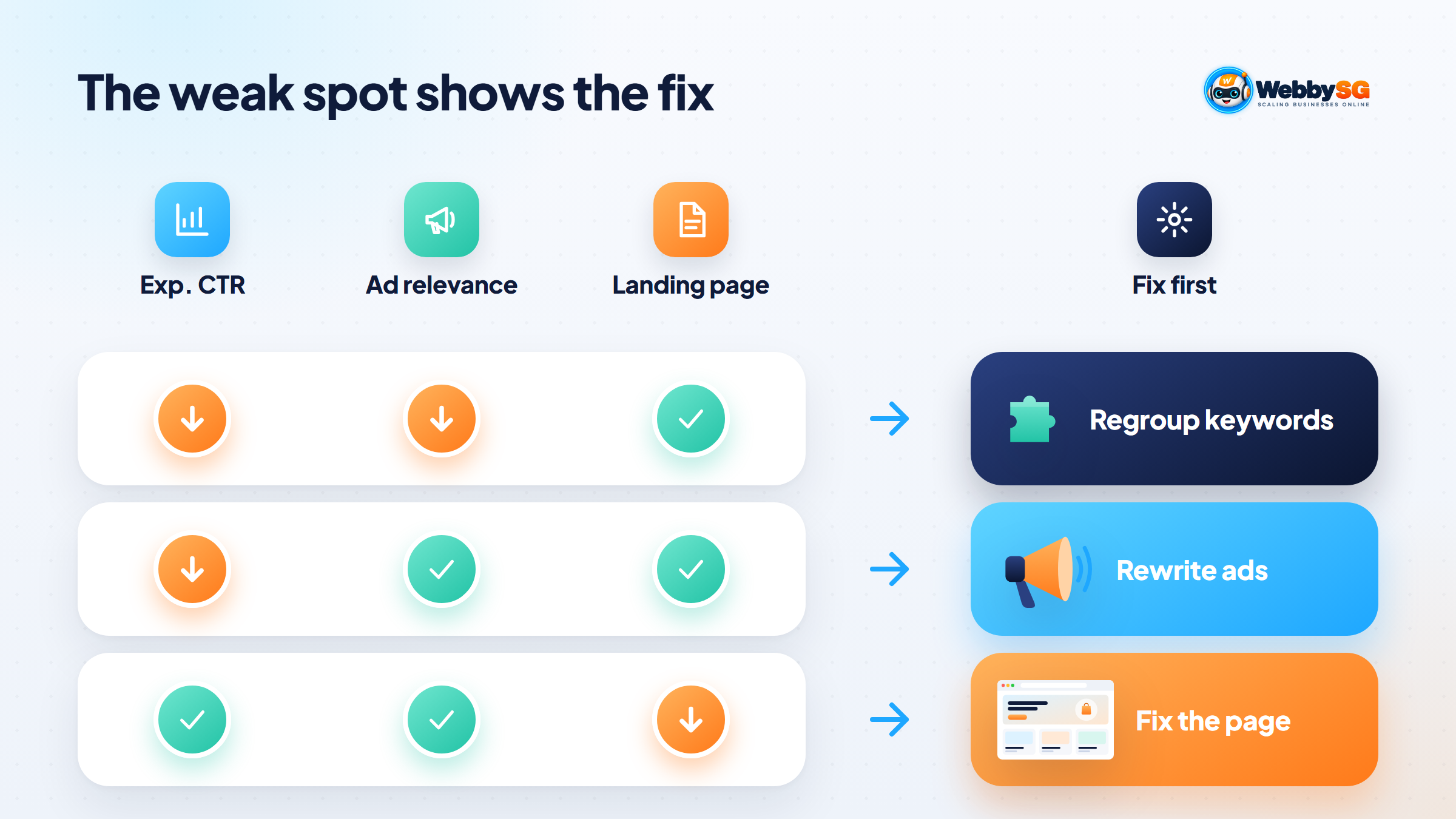
Fix order: keyword groups, ad copy, then landing page
Working in this order avoids rewriting ads or rebuilding pages for keywords that should not be grouped together in the first place.
- Tighten keyword groups. Each ad group should cover one service or product theme. "Aircon servicing", "aircon chemical wash" and "aircon repair" are different searches with different intent; giving them separate ad groups lets each ad speak directly to the search.
- Clean up search terms. Review the search terms report and add negative keywords for irrelevant searches, such as "aircon servicing job" or "aircon servicing course" for a business that only sells the service.
- Rewrite ads around the keyword theme. Use the searcher's words in at least one or two headlines, then add a reason to click: a clear offer, a starting price if you publish one, response time, areas served, licences or reviews. Use responsive search ad suggestions as prompts, not as finished copy.
- Add relevant assets. Sitelinks to individual service pages, callouts and a call asset help the ad stand out and can lift click-through rate.
- Match the landing page. Send each ad group to the page that answers that search, not your homepage.
Then leave it alone for a while. The ratings look back over 90 days of searches, so a rewrite on Monday will not show by Friday, and on low-volume keywords it can take weeks.
Landing page experience: the website fixes that matter
Landing page experience is the component most advertisers ignore, because fixing it means changing the website rather than the ad account. These are the changes that usually make the difference:
- Message match. The headline repeats what the ad promised. If the ad says "Chemical aircon wash for HDB flats", the page should say that, not "Welcome to our company".
- Mobile usability. Many service searches happen on phones. Readable text, large tap targets, no sideways scrolling and a call or WhatsApp button that works in one tap.
- Speed. Compress large images, remove sliders and unused scripts, and test the page on mobile data.
- Useful content. Prices or price ranges where you can give them, what is included, areas served, how booking works, and reviews.
- A short form. Name, phone and the one or two questions you really need, with a PDPA-compliant consent line.
- Trust signals. Business name and UEN, real photos, licences or certifications, and contact details.
Our guide on why a website is not generating leads goes deeper on the conversion side, which matters even when Quality Score is already fine.
Where Quality Score does not apply: Performance Max and automation
Quality Score is reported per keyword, so it only appears in Search campaigns. Performance Max, Demand Gen, Display and video campaigns do not use keywords in the same way and do not show a Quality Score. That does not mean ad and landing page quality stop mattering there; you simply have to judge them from conversion rate, cost per conversion and asset performance instead.
Automated bidding, such as Maximise Conversions or Target CPA, also changes how much attention the score deserves. Smart bidding sets bids per auction using signals you cannot see, so a keyword with a modest Quality Score that converts profitably is often fine to leave alone. With broad match, some keywords can show a score inherited from a matching exact-match keyword in the same ad group, so read the numbers with that in mind.
A worked example for a Singapore service business
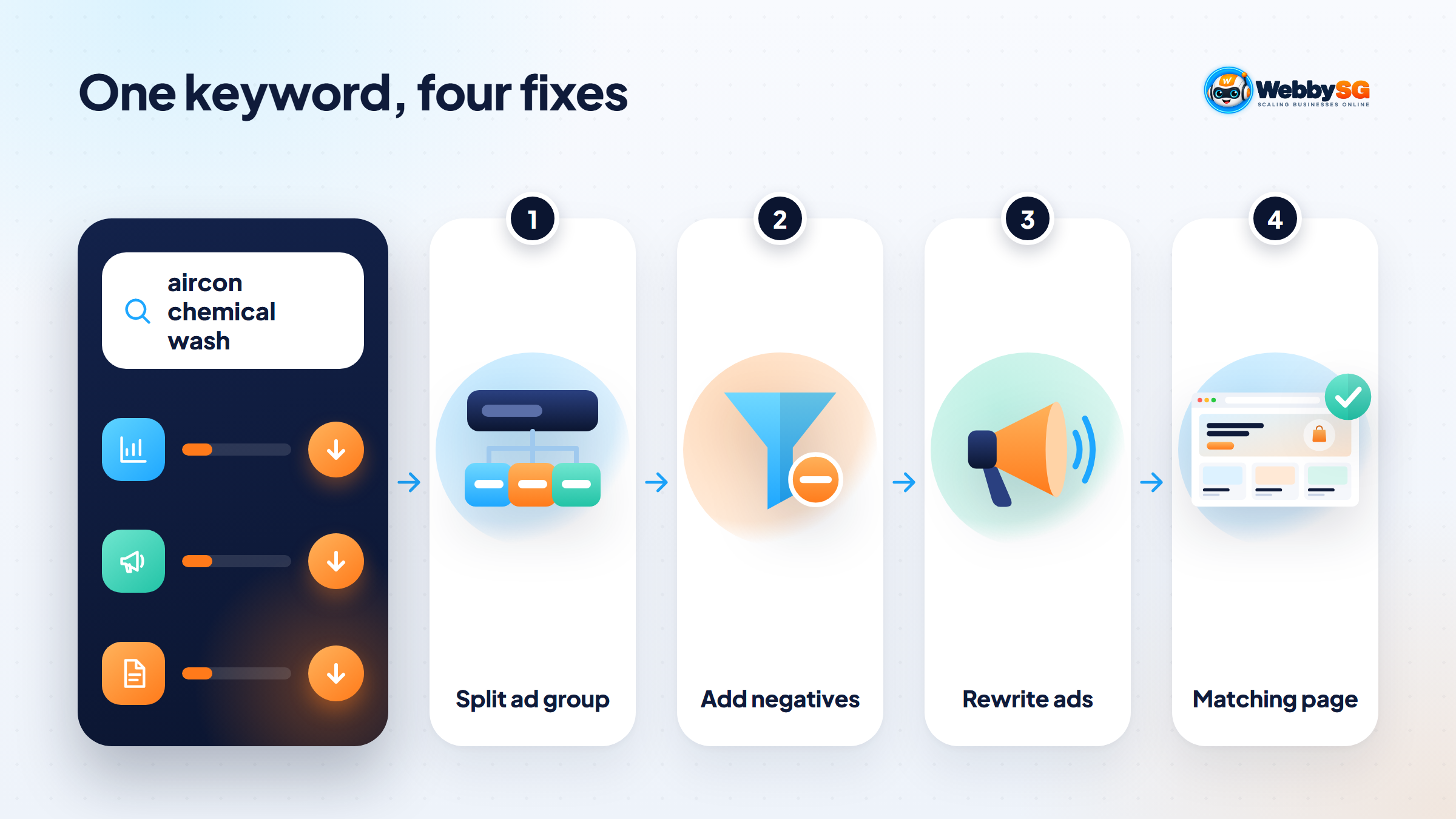
This is an illustrative example, not a client case study. An aircon servicing company runs one Search ad group called "Aircon services" containing servicing, chemical wash, gas top-up and repair keywords, all pointing to the homepage. The keyword "aircon chemical wash" shows:
- Exp. CTR: below average
- Ad relevance: below average
- Landing page exp.: below average
Reading the pattern, the ads are generic because the group mixes four services, and the homepage does not mention chemical washes above the fold. The fixes, in order:
- Split the ad group into four, one per service, and move "aircon chemical wash" and close variants into their own group.
- Add negatives for job, course and DIY searches found in the search terms report.
- Write ads with "Aircon Chemical Wash" in a headline, plus what is included, the areas served and a call asset.
- Build a chemical wash landing page: matching headline, what the service involves, how long it takes, starting price if published, real photos, reviews, a WhatsApp button and a three-field form.
What to expect: ad relevance is usually the first component to respond, because the ads now match the keyword. Expected CTR can only improve as the new ads gather clicks, and landing page experience follows once Google has assessed the new page. Results vary by competition and volume, so the business judges success by enquiries and cost per enquiry over the following weeks, not by the score itself.
Getting help with Quality Score and landing pages
Most Quality Score problems come down to account structure and landing pages, which often sit with different people. If your agency manages the ads but cannot change the website, ad relevance may improve while landing page experience stays stuck. For more on running campaigns well in Singapore, see our Google Ads guide for Singapore SMEs.
Webby SG's search engine marketing service covers campaign structure, ad copy and the landing pages behind them, so both sides are fixed together. If you would like a second opinion on your account, contact us.
Frequently asked questions
Is Quality Score a factor in the ad auction?
No. Google states that Quality Score is not an input in the ad auction; it is a diagnostic tool. The auction uses real-time measures of expected click-through rate, ad relevance and landing page experience as part of Ad Rank, so improving the things Quality Score reflects still helps.
What is a good Quality Score?
Google does not define a "good" number. In practice, aim for average or above average on all three components for your most important keywords. A keyword scoring 5 that converts profitably is better than a 9 that never produces enquiries.
How long does it take for Quality Score to update?
The ratings are based on ads shown for the same searches over the last 90 days, so improvements show gradually. High-volume keywords reflect changes sooner; low-volume keywords can take weeks. Use the historical Quality Score columns to track the trend.
Why do some keywords show no Quality Score?
A dash means there have not been enough searches that exactly match the keyword to calculate a score. This is common for niche or long-tail keywords in a small market like Singapore. Judge those keywords by conversions and cost per conversion instead.
Can a better landing page lower my cost per click?
It can help. Landing page quality is part of the ad quality Google uses in Ad Rank, and Google says higher quality ads can often lead to lower costs per click. A better page also tends to convert more of the clicks you already pay for, which usually matters more for your cost per lead.