Instagram Ads Singapore: Costs, Setup and Verification
How Singapore SMEs can run Instagram ads: Meta verification rules, setting a test budget in SGD, formats, local targeting, WhatsApp and conversion tracking.
Instagram ads in Singapore are bought through Meta, the same system that runs Facebook ads. You can boost a post from the Instagram app or build a full campaign in Meta Ads Manager, and either way you choose an objective, an audience, a budget and where people go after they tap. What is specific to Singapore is verification: Meta requires every advertiser whose ads reach Singapore audiences to verify who pays for the ads and who benefits from them, and a new police code of practice is tightening advertiser identity checks further. For most SMEs, a two-week test with one clear goal, a simple audience and proper tracking is the sensible way to start.
In short
- Instagram ads run through Meta. Use Ads Manager for real campaigns; the in-app Boost button is fine for a quick test of a single post.
- Meta requires advertisers reaching Singapore audiences to complete verification and name a verified beneficiary and payer, which are shown with the ads.
- Under the Online Criminal Harms Act, the police issued a Code of Practice for Social Media Services in August 2026 that requires platforms to verify advertisers' identities against government records. Platforms must comply by 31 January 2027.
- There is no fixed price per click or per thousand views. Cost depends on audience, competition, objective and creative, so set a test budget you can afford to learn with.
- Track results with the Meta Pixel and the Conversions API, or you will be judging ads on likes instead of enquiries and sales.
How Instagram ads in Singapore work (through Meta Ads Manager)
Instagram does not have a separate ad platform. According to Meta's Instagram advertising page, you can create ads in three ways: promote a post directly in the Instagram app, use Ads Manager (the same tool used for Facebook ads), or work with a Meta marketing partner. In every case you set a destination, an audience, a budget and a duration, then publish.
An Ads Manager campaign has three levels:
- Campaign: the objective, such as awareness, traffic, engagement, leads or sales. Meta optimises delivery towards this goal, so choose the one that matches what you actually want.
- Ad set: the audience, budget, schedule and placements. This is where you choose Instagram placements (Feed, Stories, Reels, Explore) or let Meta place ads across Facebook and Instagram.
- Ad: the creative, caption, call-to-action button and destination.
You can run a campaign on Instagram only or on both apps, then check results by placement.
Setting up: business portfolio, verification and payment
Before your first campaign, get the accounts right. These are the steps in order:
- Switch Instagram to a business account. Meta's Instagram ads page says you need one to run ads and that it is free; it takes a couple of minutes in the app's settings.
- Create a Meta business portfolio (formerly Business Manager) in your company's name, and add your Facebook Page, Instagram account and ad account to it.
- Complete verification. In Business Settings, under authorisations and verifications, verify the business or individuals who pay for and benefit from the ads. Meta says this may need business documents or a one-time code sent to an email on your company's web domain.
- Set the beneficiary and payer. Once verified, choose which verified beneficiary and payer appear with your ads, either as a default in Ads Manager's advertising settings or per ad set.
- Add a payment method and check the ad account's currency and time zone. Use SGD and Singapore time unless you have a reason not to, because these are hard to change later.
- Give your agency access, not ownership. If someone runs ads for you, add them as a partner to your portfolio rather than letting them create the accounts.
Why Singapore verification matters
Meta's developer announcement states that all advertisers delivering ads to audiences in Singapore, including global campaigns, must complete these verification and transparency steps. Ads that do not comply may be rejected or paused, and the verified beneficiary and payer are disclosed with the ads.
This is linked to Singapore's anti-scam rules. The Singapore Police Force's Code of Practice for Social Media Services, issued under the Online Criminal Harms Act, requires designated platforms to verify advertisers' identities by checking government-issued records, to screen ads for suspicious content before publication, and to block financial services ads to Singapore users unless the advertiser is licensed by the Monetary Authority of Singapore or another applicable authority, or authorised by a licensed entity. When the code was announced in August 2026, Facebook, Instagram and TikTok were given until 31 January 2027 to comply. Its definition of "advertiser" includes agencies, content creators and influencers involved in an ad.
For a legitimate SME the practical effect is small but real. Verify early, use the same registered business name and UEN that appear in your ACRA records on your website and in your Meta portfolio, and leave a few working days for checks before a promotion goes live. A sale timed for 11.11 or Chinese New Year is a bad moment to discover your payer details do not match.
What Instagram ads cost in Singapore
Meta sells ads by auction, so there is no price list. What you pay per result depends on competition for the audience, your objective, the relevance of your ad and the season; festive periods and year-end sales tend to be more competitive.
We do not quote average cost-per-click or cost-per-thousand figures here because we found no current, dated source for Instagram in Singapore, so treat unsourced figures with caution. Ads Manager flags it if your daily budget is below the minimum for your currency and objective.
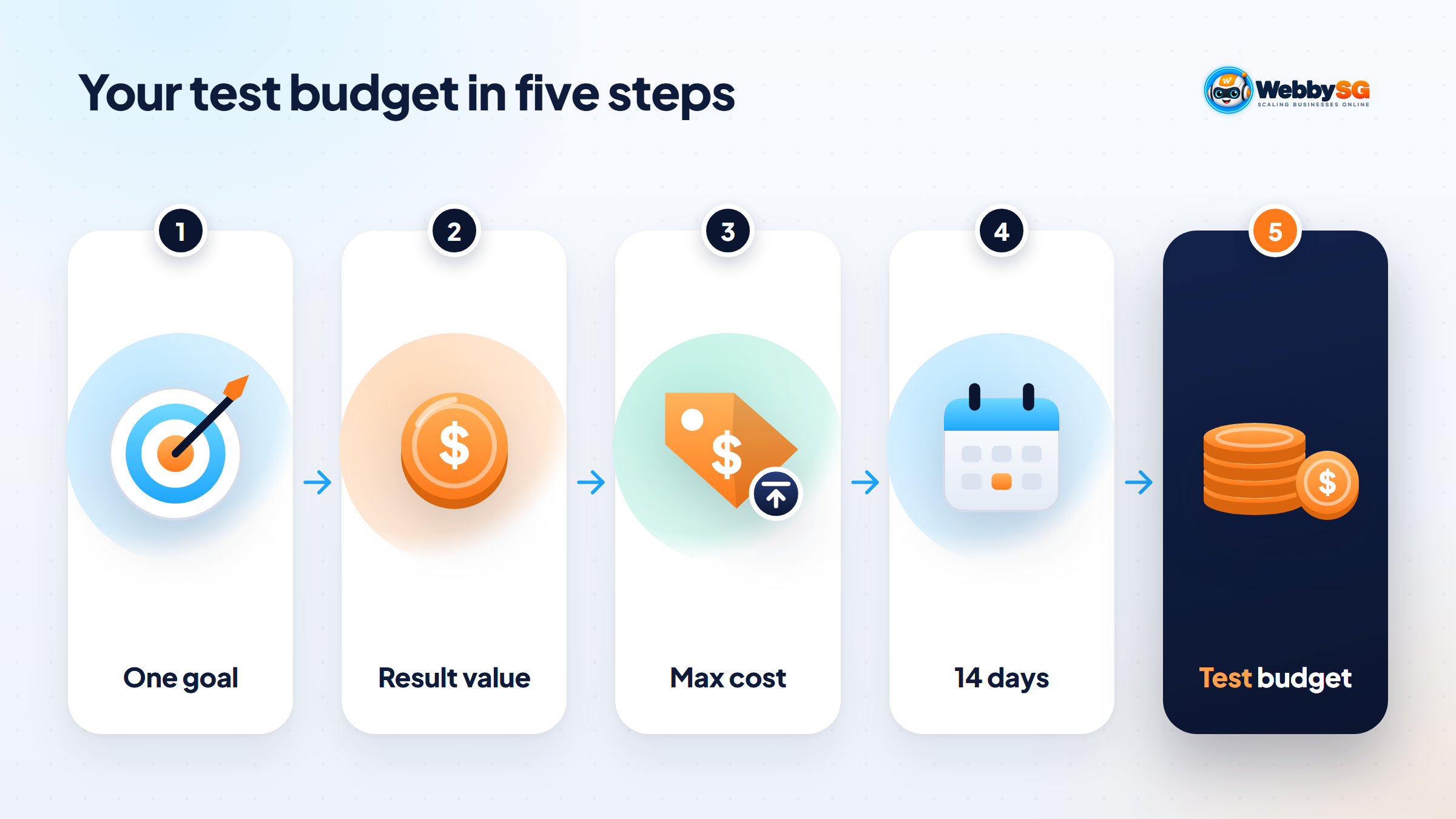
The better question is how much you need to learn something. A simple way to set a test budget:
| Step | What to decide | Example (illustrative, not a benchmark) |
|---|---|---|
| 1. Pick one goal | Enquiries, WhatsApp chats, bookings or online sales | WhatsApp enquiries for a home service |
| 2. Know what a result is worth | Average job or order value and your close rate | One in five chats becomes a S$400 job |
| 3. Set an affordable cost per result | The most you can pay and still profit | Up to S$30 per chat |
| 4. Set the test length | At least two weeks so delivery can settle | 14 days |
| 5. Fund enough results to judge | Budget for a meaningful number of results, not one or two | S$30 a day × 14 days = S$420 |
After the test, compare the actual cost per result with your affordable figure. If it is far above, change the offer, creative or audience before adding budget; if below, scale up gradually.
Formats: Reels, Stories, feed, carousel and partnership ads
People scroll Instagram on their phones with the sound often off, so the format and the opening second of the creative do more work than the caption ever will.
| Format | Good for | Tip |
|---|---|---|
| Reels ads (full screen, vertical) | Reach; showing a product or service in action | Show the product or result in the first seconds |
| Stories ads (full screen) | Short offers, events, promotions | Keep text away from the top and bottom edges |
| Feed image or video | Simple offers and announcements | Square or portrait takes more screen than landscape |
| Carousel | Several products, before-and-after, steps | Make the first card earn the swipe |
| Partnership ads | Running from a creator's handle with your brand | Agree usage rights and disclosure in writing |
A good start is two or three short vertical videos plus one carousel, all with the same offer, so a small budget is not spread too thin.
Targeting Singapore audiences by area and interest
Singapore is small enough that island-wide targeting is cheap to set up and easy to waste. The useful question is which part of the island, and which people in it.
- Location: target the whole country for online sales, or drop a pin on your outlet and set a radius if you serve a neighbourhood. For a clinic, café or tuition centre, a tight area around the premises usually beats island-wide reach.
- Interests and behaviours: useful for a first test, but keep them broad; very narrow audiences in a small market deliver slowly.
- Custom audiences: website visitors (via the Pixel), Instagram engagers and customer lists. Only upload customer lists where your PDPA consent covers this use.
- Lookalikes and broad targeting: once you have conversion data, letting Meta find similar people often outperforms hand-picked interests.
The digital marketing guide for small businesses covers how paid social fits alongside search, SEO and email if you are deciding where to spend first.
Choosing the destination: website, lead form or WhatsApp
Where people land after tapping the ad decides more of your results than the targeting does.
| Destination | Best when | Watch out for |
|---|---|---|
| Website or landing page | You sell online or need people to read details first | Slow or desktop-first pages waste paid clicks; track with the Pixel |
| Instant form (lead ad) | You want many enquiries with little friction | Lead quality can be lower; add a qualifying question and follow up fast |
| WhatsApp chat | Customers want to ask before buying, which is common in Singapore | Someone must reply quickly, including evenings and weekends |
| Instagram Direct | Your audience already lives on Instagram | Harder to track to a sale; keep a simple log of chats and outcomes |
Whichever you choose, the page or chat must match the ad: an ad for an aircon servicing offer should land on that offer, not your homepage. If paid clicks arrive but enquiries do not, our guide on why a website is not generating leads walks through the usual causes.
Forms and lead ads collect personal data, so PDPA applies: say why you are collecting details, get consent for marketing, and protect the data once you have it.
Tracking results with the Meta Pixel and Conversions API
Without tracking, Meta can only optimise for clicks and engagement. Set up both:
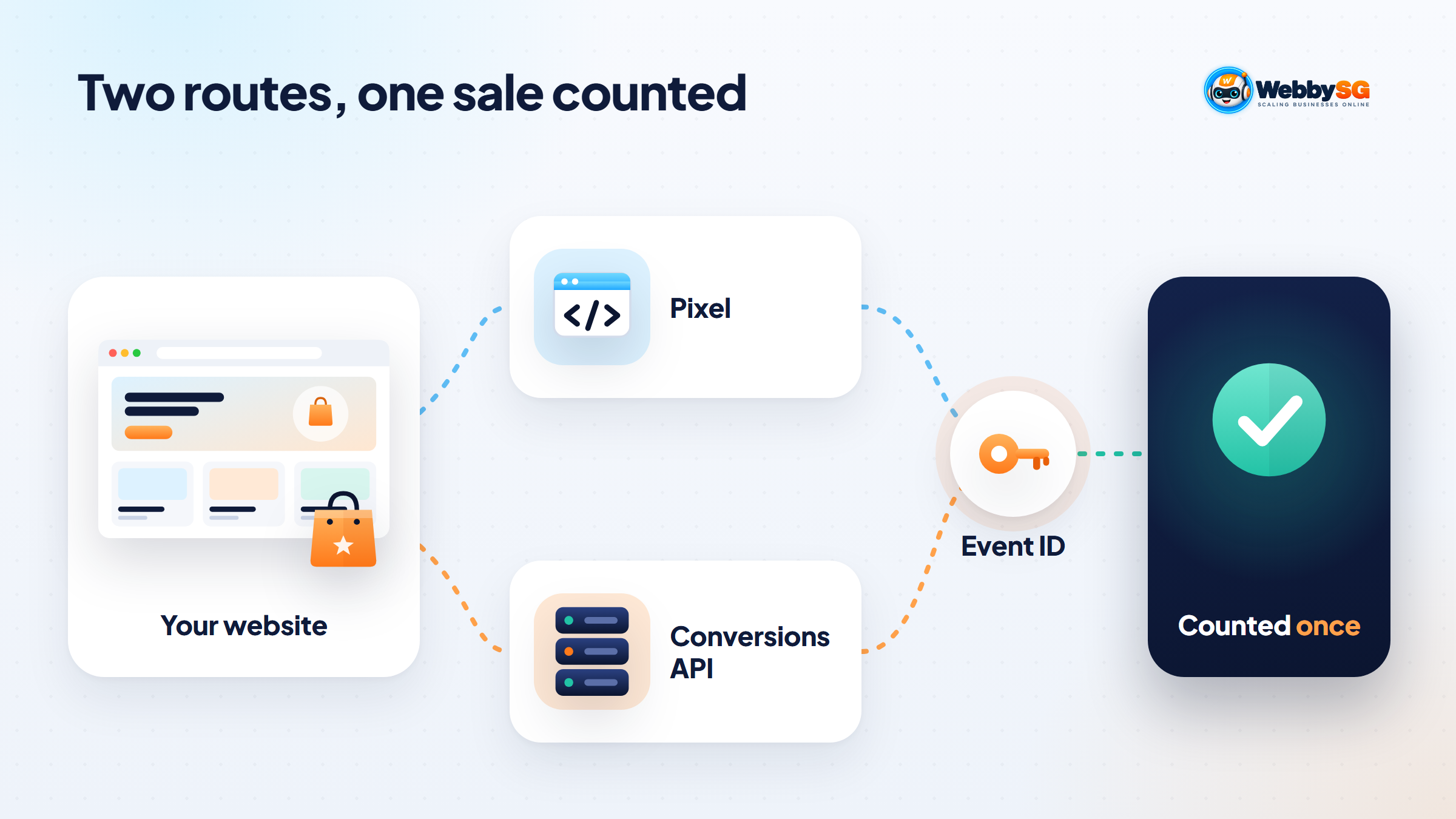
- Meta Pixel: a code snippet on your website that records events in the browser, such as page views, add to cart, lead and purchase.
- Conversions API: a server-side connection that sends the same events from your website, platform or CRM to Meta. Meta's Conversions API documentation says it can be set up from Events Manager if you already have a Pixel, and that you should confirm events are received, deduplicated and matched correctly.
- Deduplication: when both send the same purchase, a shared event ID tells Meta it is one sale, not two.
- Test before spending: use Events Manager's test tools to submit a real enquiry or purchase and check it arrives once.
- Consent: mention the Pixel and similar tracking in your privacy policy.
Shopify, WooCommerce and other major platforms have Meta integrations; on a custom site, plan this into the build.
Boosting a post vs running a proper campaign
The Boost button in the Instagram app is quick and fine for putting reach behind a post that is already doing well. It is weaker as a growth tool: fewer objectives and targeting options, and limited testing.
| Boost in the app | Ads Manager campaign | |
|---|---|---|
| Set-up time | Minutes | Longer, more decisions |
| Objectives | A short list of goals | Full set, including leads and sales |
| Creative testing | One post at a time | Several ads per ad set, compared side by side |
| Optimising for conversions | Limited | Yes, with Pixel and Conversions API events |
| Best for | Extra reach on a strong organic post | Enquiries, sales and ongoing campaigns |
If you are spending regularly, move to Ads Manager. Instagram is also only one channel: if people already search for what you sell, Google Ads for Singapore SMEs may capture that demand more directly, and YouTube ads suit longer video stories.
Getting help with Instagram ads
Many owners run their first campaigns themselves. Help is worth considering when verification stalls, when tracking is not recording leads or sales, or when monthly spend is high enough that weak creative costs real money. Whoever runs the ads, keep the portfolio, ad account and Pixel in your company's name.
Webby SG's social media advertising service covers Meta campaign set-up, creative testing and conversion tracking for Singapore businesses. If you would like someone to check your account or tracking first, get in touch.
Frequently asked questions
Can I run Instagram ads without a Facebook Page?
For a quick boost from the Instagram app, whether Meta asks you to link a Facebook Page has varied from account to account, so follow the prompts you see. For Ads Manager campaigns, tracking and Singapore verification you need a Meta business portfolio and ad account, and connecting a Facebook Page is the normal set-up. Doing it properly at the start saves rework later.
What is the minimum budget for Instagram ads?
Meta's minimum daily budget depends on your currency, objective and how you are charged, and Ads Manager flags a figure that is too low. The practical minimum is what buys enough results to judge an ad: your affordable cost per result times the results you want in a two-week test.
Are Instagram ads cheaper than Facebook ads?
Not by rule. Both are sold through the same Meta auction, and cost depends on audience, objective, competition and creative rather than the app. The best way to find out for your business is to run one campaign with automatic placements and compare cost per result by placement in Ads Manager.
Why was my Instagram ad rejected?
Common reasons are content that breaks Meta's advertising standards, restricted categories such as financial services, landing pages that do not match the ad, and incomplete verification for ads reaching Singapore. Under Singapore's Code of Practice for Social Media Services, platforms must also block financial services ads from advertisers not licensed by MAS or another relevant authority. Check the reason in Account Quality and request a review if you think it was wrong.
How long before Instagram ads show results?
Ads start delivering once approved, but the first week is often unstable while Meta learns who responds. Judge a campaign after about two weeks and a reasonable number of results. Frequent edits restart the learning, so change one thing at a time.