Google Ads vs Facebook Ads: Which Suits Your SME?
Google Ads vs Facebook Ads for Singapore SMEs: how intent, cost, targeting and formats differ, a starter budget split, and how to measure both fairly.
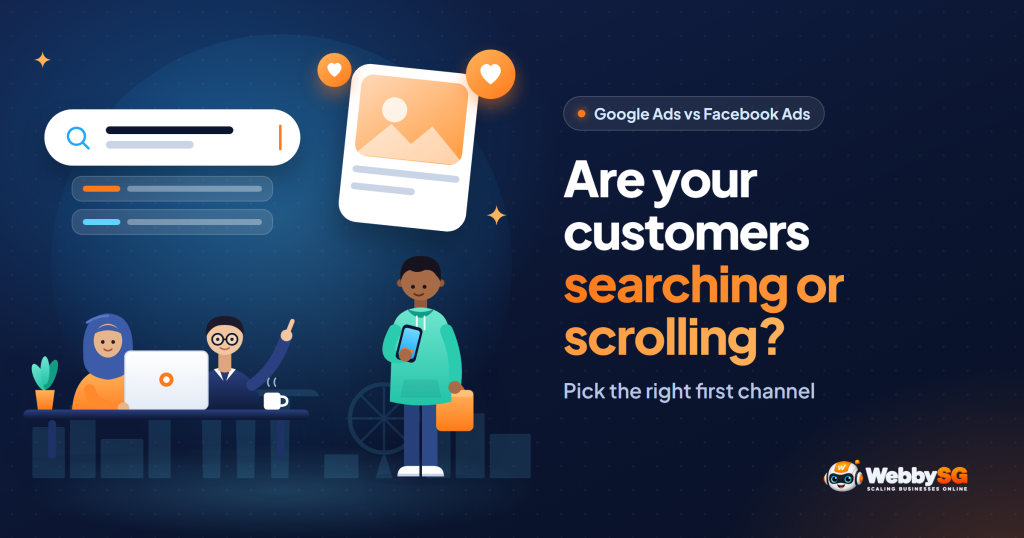
Google Ads vs Facebook Ads comes down to one question: are your customers already searching for what you sell? Google Ads shows your ad to people who type a need into Google, so it captures demand that already exists. Facebook Ads (run through Meta, which also covers Instagram, Messenger and WhatsApp) shows your ad to people based on who they are and what they are interested in, so it creates demand among people who were not looking yet. For most Singapore service businesses that rely on enquiries, Google is the better first channel. For visual products, new ideas and repeat purchases, Meta often wins. Plenty of SMEs end up running both, but only once each platform has a clear job.
This guide is for owners and marketing leads deciding where to put a limited ad budget. It compares the two platforms on the points that matter, suggests a starting split, and explains why the results each platform reports cannot simply be added together.
In short
- Google Ads reaches people with intent: they are searching now. Meta Ads reaches people by profile and interest: they are scrolling, not searching.
- Service businesses with urgent or specific needs (aircon repair, renovation, legal, B2B services) usually start with Google. Visual, impulse or novel products usually start with Meta.
- Neither platform is "cheaper" in a useful sense. Compare cost per qualified enquiry or cost per sale, not cost per click.
- Google's average daily budget can spend up to twice the daily amount on a busy day, but no more than 30.4 times it over a month.
- Google and Meta will often both claim the same sale. Judge them against your own leads and sales records, not by adding their dashboards together.
The core difference: demand capture vs demand creation
On Google Search, the customer makes the first move. Someone types "aircon servicing Tampines" or "corporate secretarial services Singapore", and your ad competes to appear next to that query. The intent is clear and often urgent, which is why search leads tend to convert well. The limit is volume: you can only reach as many people as are searching, and you cannot create searches that do not exist.
On Facebook and Instagram, you make the first move. You choose an audience (location, age, interests, or people similar to past customers), and Meta shows your ad while they browse. Nobody asked for it, so the ad has to earn attention in a second or two. In return, you can reach people before they know they need you: a new bakery's opening, a home organisation service, a skincare launch.
Put simply, Google harvests demand and Meta plants it. The mistake is expecting one to do the other's job, such as running Meta ads for an emergency plumbing service, or Google ads for a product nobody yet knows to search for.
Google Ads vs Facebook Ads side by side: targeting, formats, cost and lead quality
| Factor | Google Ads | Facebook (Meta) Ads |
|---|---|---|
| How people are reached | Keywords people search for, plus Display, YouTube and Performance Max inventory | Audiences built on location, demographics, interests and lookalikes of existing customers |
| User mindset | Actively looking for a solution | Browsing; not looking for you yet |
| Main formats | Text search ads, Shopping ads, display banners, YouTube video | Image, video, carousel, Reels and Stories, instant forms, click-to-message ads |
| Campaign goals | Sales, leads, website traffic and other goal-based campaign types | Six objectives: Awareness, Traffic, Engagement, Leads, App promotion and Sales |
| Typical cost pattern | Higher cost per click on competitive service keywords, but clicks carry intent | Lower cost to reach people, but more of them are casual; creative quality drives results |
| Lead quality | Usually higher for enquiry-led services | Varies widely; instant forms bring volume, but quality needs checking |
| What you must supply | Good keywords, negative keywords and a landing page that matches the search | A steady supply of strong images and short videos |
On cost: published cost-per-click figures are mostly from US advertisers and vary sharply by industry, so they are a poor guide for a Singapore SME. Your own numbers after a few weeks matter far more. The figure that decides which platform is "cheaper" is cost per qualified enquiry or cost per sale, and that depends on your offer, your page and how well each platform's audience fits.
On messaging: Meta lets you send ad clicks straight into a WhatsApp, Messenger or Instagram chat. Many Singapore SMEs prefer this to a web form, because customers here are used to asking questions on WhatsApp. Google offers call and message options too, but the click-to-WhatsApp habit is stronger on Meta.
Which to choose by business type
Use this as a starting point, then let your own results decide.
| Business type | Start with | Why |
|---|---|---|
| Home services (aircon, plumbing, cleaning, pest control) | Needs are urgent and searched for by area and service | |
| Renovation and interior design | Both | Google for people ready to get quotes; Meta to show finished projects to people planning a move |
| B2B services (accounting, IT support, corporate services) | Buyers search for specific services; Meta interest targeting is less precise for business roles | |
| F&B, cafés and beauty | Meta | Visual, local and impulse-driven; Instagram suits the format |
| E-commerce, known product category | Both | Google Shopping captures people searching for the product; Meta finds new buyers and brings back past visitors |
| E-commerce, new or unusual product | Meta | People do not yet know to search for it |
| Education, courses and tuition | Both | Parents search for subjects and levels; Meta reaches them around exam and enrolment periods |
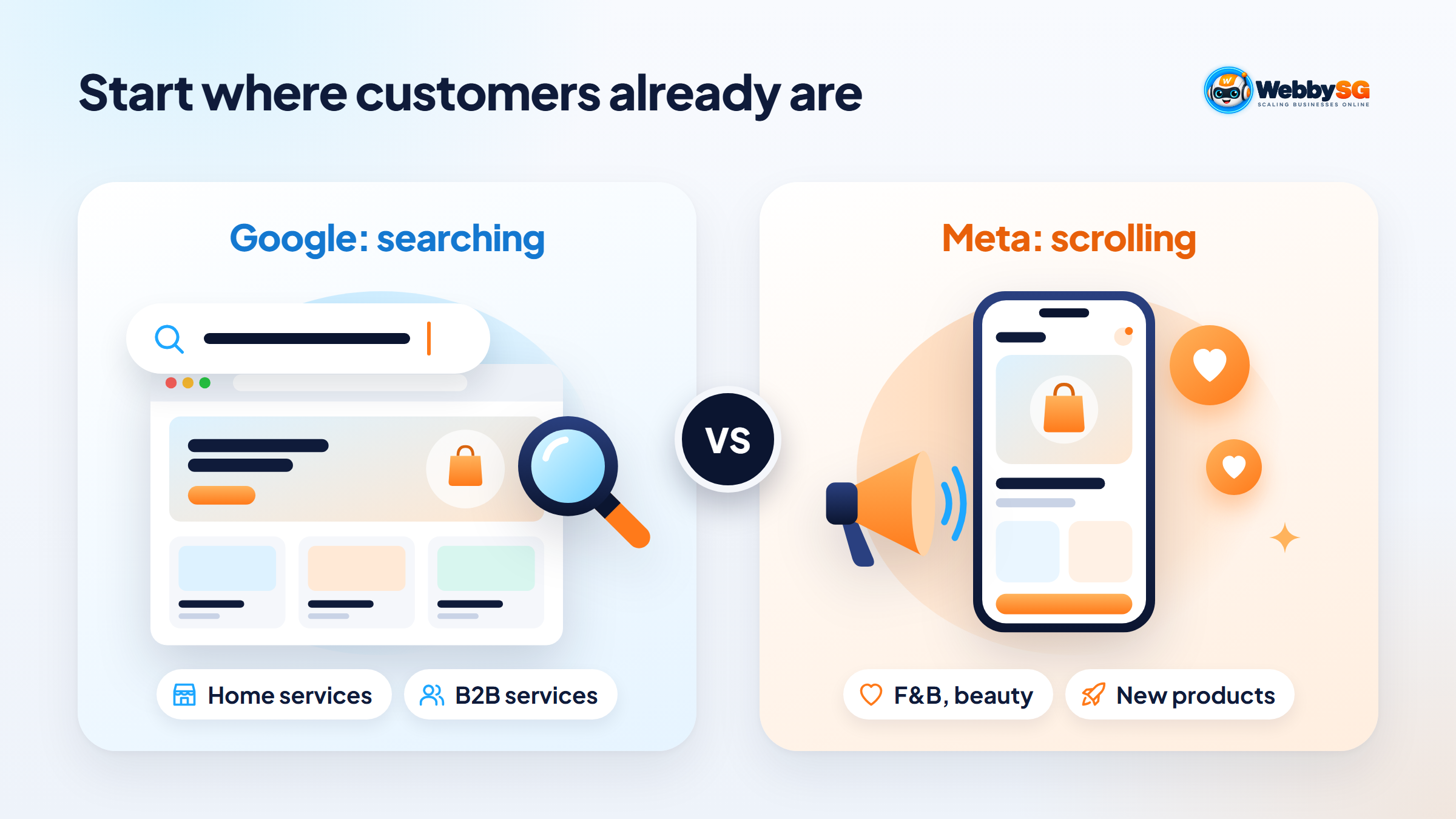
If you are unsure, ask two questions. Do people search for what you sell, in words you can list? If yes, start with Google. Does your offer look good in a photo or a 15-second video? If yes, Meta is worth testing. If both answers are yes, plan to run both once the first channel is working.
A starter budget split for small budgets
The splits below are starting points we suggest for testing, not benchmarks. Adjust them after four to six weeks based on cost per qualified lead or sale.
- Enquiry-led service business: about 70–80% Google Search, 20–30% Meta, mainly remarketing to website visitors and click-to-WhatsApp ads.
- Visual or local consumer business (F&B, beauty, retail): about 70% Meta, 30% Google, covering your brand name and the most specific searches.
- E-commerce: start around 50/50 between Google Shopping or Search and Meta, then move budget toward whichever brings the lower cost per sale.
- Very small budget: pick one platform and do it properly. Splitting a small budget across two platforms gives each too little data to learn from.
On Google, remember how the budget works. Google's help page on average daily budgets explains that a campaign might spend up to twice its average daily budget on a single day, but over a month it will not charge more than 30.4 times the daily amount. So a S$20 daily budget means up to about S$608 a month, not exactly S$20 every day.
A worked example, with made-up but realistic numbers: a home cleaning company has S$1,500 a month to spend. At a 75/25 split, about S$1,125 goes to Google Search, which works out to an average daily budget of roughly S$37 (S$1,125 divided by 30.4). The remaining S$375, about S$12 a day, runs Meta remarketing to people who visited the pricing page but did not book. After six weeks, the owner compares cost per confirmed booking from each source in the booking sheet, not in the ad dashboards, and moves money accordingly.
Keep a little budget unallocated in the first month. One keyword group or ad nearly always earns more than you expected.
How to run both together
The two platforms work best when each has a clear job:
- Meta introduces, Google closes. Someone sees your renovation portfolio on Instagram, then searches your company name weeks later. Run a small Google campaign on your brand name so a competitor's ad is not the first thing they see.
- Google brings visitors, Meta brings them back. Most visitors leave without enquiring. Meta remarketing to recent website visitors is a low-cost way to remind them, for example with a project photo, a review or a limited-time offer.
- Share what you learn. Search terms that convert on Google tell you which words and pain points to use in Meta ads. Meta ads that get the most comments and saves tell you which angle to test in Google ad copy.
Both depend on the page people land on. If the landing page is slow, vague or hard to use on a phone, neither platform will fix it. Our guide on why a website is not generating leads covers the usual causes.
Measuring results without double counting
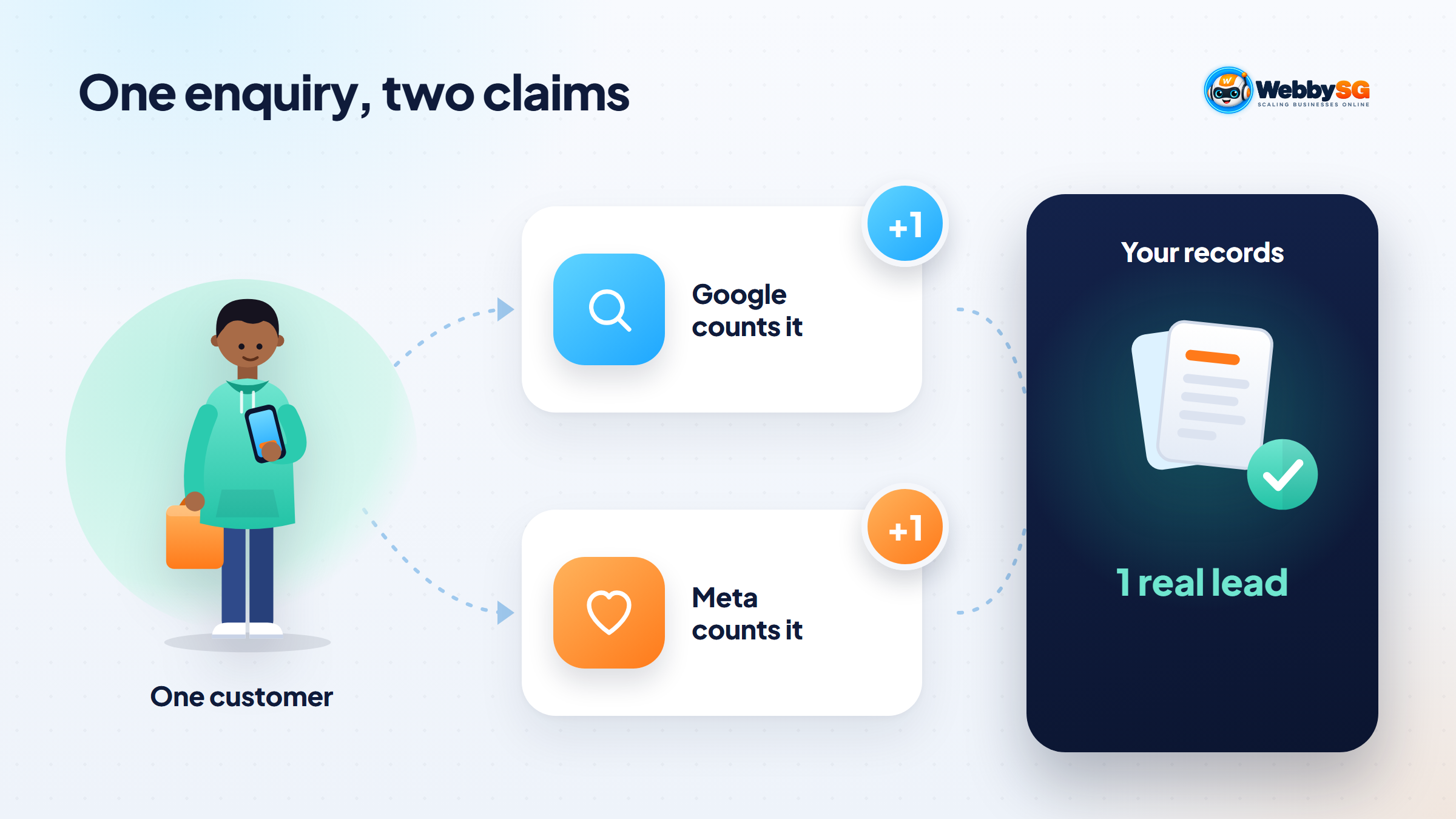
This is where many SMEs go wrong. Google and Meta each count conversions using their own rules, and both can claim the same customer.
Take one person who sees your Instagram ad on Monday, clicks a Google search ad on Thursday and fills in your form. Meta may count that enquiry because it falls within its attribution setting. Google may count it too: by default, Google Ads counts conversions within a 30-day conversion window after a click, adjustable from 1 to 90 days. Add the two dashboards together and you have two enquiries where your inbox shows one.
A practical way to measure:
- Count real leads and sales in one place. A spreadsheet or CRM with every enquiry and sale, and where each one came from.
- Ask "How did you hear about us?" on forms and in your first WhatsApp reply. It is imperfect, but it catches what tracking misses.
- Use UTM tags on every ad link so Google Analytics can separate Google, Facebook and Instagram traffic.
- Compare total spend to total results. Divide combined ad spend by the real number of qualified leads or sales. That blended figure is the one that pays your bills.
- Test by switching off. If you pause one platform for a few weeks and total enquiries barely move, it was taking credit for leads that would have come anyway.
For reading the Google side in detail, see our guide on how to read a Google Ads report.
Common mistakes when switching platforms
- Judging too early. Both platforms need time and data to optimise. Switching after a week of poor results usually means starting the learning over on the other platform.
- Copying ads across unchanged. A search ad answers a query; a Meta ad has to stop someone scrolling. They need different copy, and Meta needs visuals.
- Using broad targeting on a tiny budget. On Google, broad keywords without negative keywords waste money on irrelevant searches. On Meta, a vague audience with weak creative gets cheap clicks that never enquire.
- Counting form fills, not customers. Meta instant forms can produce many leads with wrong numbers or low interest. Track how many leads answer the phone and buy.
- Ignoring what competitors run. Google's Ads Transparency Center and Meta's Ad Library both let you see the ads other advertisers are running, which is a free way to check your market before you start.
- Forgetting the website. If you switch platforms but keep a weak landing page, results will stay weak.
Getting the platform choice right
If you want a deeper look at search advertising for a small business, our Google Ads guide for Singapore SMEs covers campaign set-up step by step. Webby SG manages Google Ads through our search engine marketing service, and Facebook and Instagram campaigns through our social media advertising service. If you are not sure which suits your business, tell us about your goals and we will give you a straight answer.
Frequently asked questions
Is Google Ads cheaper than Facebook Ads?
Facebook and Instagram usually cost less to reach people, while Google search clicks often cost more because they come from people actively looking. But cost per click is the wrong comparison. What matters is cost per qualified enquiry or sale, which depends on your industry, offer and landing page, so test both and compare those numbers.
Is $10 a day enough for either platform?
S$10 a day can be enough to test a tightly focused campaign, such as a few specific local search terms on Google or remarketing to past visitors on Meta. It is rarely enough to cover broad keywords or wide audiences, and it is too little to split across both platforms. On Google, a S$10 average daily budget can spend up to S$20 on a busy day but no more than S$304 over a month.
Which is better for ecommerce?
For products people already search for, Google Shopping ads tend to bring buyers who are ready to purchase. For new, visual or impulse products, Meta is usually stronger at finding new customers. Most established online stores use both: Google to capture searches and Meta to reach new buyers and bring back people who viewed products.
Should I use Instagram ads or Facebook ads?
You do not have to choose. Both are run from Meta Ads Manager, and the same campaign can show on Facebook, Instagram, Messenger and other Meta placements. Let Meta place ads automatically at first, then check the placement breakdown and adjust if one clearly performs better for your audience.
How long before I see results?
Search ads can bring enquiries within days of launch, because the people searching are already looking. Meta campaigns often need a few weeks to settle as the system learns who responds. Plan for at least four to six weeks of steady spending before deciding whether a platform works for your business.
Related reading: Instagram Ads Singapore: Costs, Setup and Verification.