Content Marketing Strategy for Singapore SMEs
Build a content marketing strategy a small Singapore team can run: goals, topics from customer questions, a realistic monthly output and lead tracking.
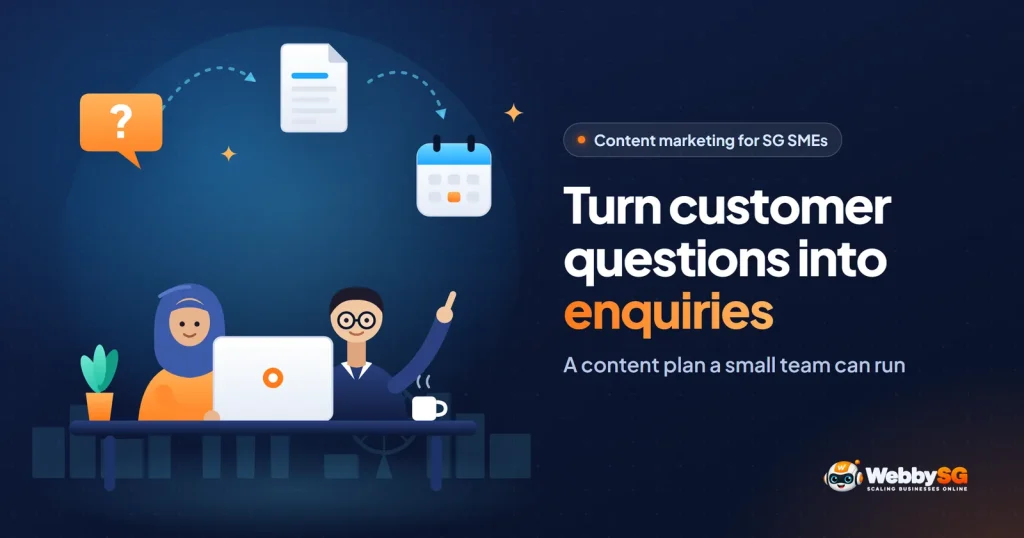
A content marketing strategy is a written plan for which content you publish, who it is for, where it appears and how you will know whether it brings in business. For a Singapore SME without a content team, a good strategy is short and practical: two or three goals tied to enquiries, a list of topics taken from real customer questions, a monthly output your team can sustain, and lead tracking in Google Analytics 4 so you can see which pages produce enquiries. Most small businesses should strengthen their service pages first, then add a small number of helpful guides each month, and reuse each piece on Google Business Profile, social media and email.
This guide sets out that plan step by step, sized for an owner or a one-person marketing team.
In short
- Set goals around enquiries and sales, with traffic as a supporting measure.
- Take topics from the questions customers already ask your staff, then check them against search data.
- Publish in this order: service pages, then answer-led guides, then supporting social posts.
- For a small team, two to four solid pieces a month, each reused across channels, is a realistic start.
- Google says there are no special requirements to appear in AI Overviews or AI Mode: helpful, indexed, people-first pages are what count.
- Track enquiries as key events in GA4 so you can see which pages and topics actually bring in enquiries.
What a content marketing strategy is for a small business
Large companies treat content strategy as a department with editors, calendars and production budgets. A small business needs something lighter: a one- or two-page document that answers five questions.
- Who are we writing for? Your two or three main customer types.
- What do they need to know before buying? The questions, doubts and comparisons they raise.
- What will we publish? The pages, guides and posts that answer those questions.
- Where will it appear? Website, Google Business Profile, social media, email.
- How will we measure it? The enquiries and sales it produces.
Write the answers down, even as bullet points in a Google Doc. That page is your content marketing strategy, and it is far more use than a 30-slide deck nobody opens after the kick-off meeting.
Set goals tied to enquiries, not traffic alone
Traffic is easy to grow with the wrong content. A post on a broad, popular topic may bring thousands of visitors who will never buy from a Singapore renovation firm or accounting practice. Tie your goals to outcomes:
| Goal type | Example | How to measure |
|---|---|---|
| Lead generation | More quote requests for a specific service | Form submissions, WhatsApp and call clicks from content pages |
| Sales support | Fewer repeated pre-sales questions | Sales team links to guides instead of retyping answers |
| Search visibility | Rankings for service and question searches | Search Console impressions and clicks per page |
| Trust | Prospects arrive already informed | Enquiries that mention a guide, shorter sales cycles |
Pick one primary goal for the next six months. For most SMEs, that is more qualified enquiries from search.
Find topics from customer questions and search data
The best topics are usually already in your inbox. Spend an hour collecting questions from these sources:
- WhatsApp chats and enquiry emails from the last three months
- Questions your sales staff answer on every call
- Google Business Profile questions and reviews
- Objections that lose deals: price, timing, trust, alternatives
- Google's "People also ask" boxes for your main services
- Search Console queries where your pages appear but get few clicks
Then group the questions into three to five content pillars. A Singapore aircon company might use pillars such as servicing and maintenance, repairs and faults, buying and installation, and costs. Each pillar should link to a service page, because that is where enquiries happen.
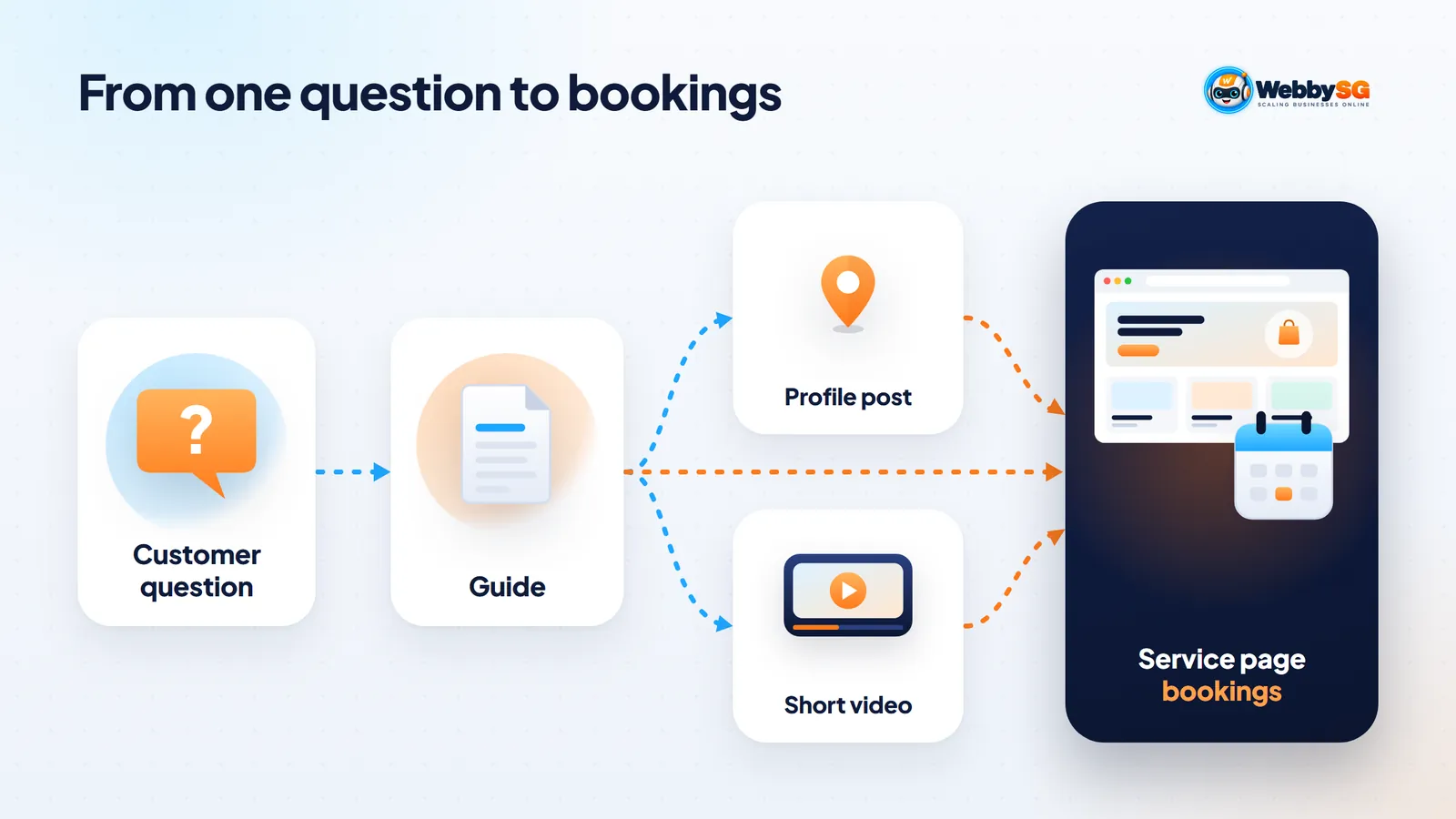
To make that concrete with the same example business: one recurring WhatsApp question, "why is my aircon leaking water?", becomes a guide on common causes and when a chemical wash is needed. The guide links to the chemical wash service page, a short version goes out as a Google Business Profile post, and a 20-second video of a technician clearing a blocked drain pipe goes on Instagram and TikTok. One question, four pieces, all pointing to a page that takes bookings.
Check each topic against two filters: does it relate to something we sell, and would the person asking it plausibly become a customer? If the answer to either is no, move on.
What to publish first: service pages, guides or social posts
Many businesses start with a blog while their service pages are thin. That is usually the wrong order, because service pages are where buyers decide.
- Service pages first. One page per main service, explaining what is included, who it suits, how it works, typical prices or price factors, and how to enquire.
- Answer-led guides second. Detailed answers to the questions buyers ask before choosing, such as costs, comparisons and "how to choose" guides, each linking to the relevant service page.
- Proof content third. Project write-ups, before-and-after photos and customer stories you have permission to share.
- Social posts alongside. Short versions of the guides and proof content, pointing back to the website.
If your website itself needs work before content can perform, our guide to digital marketing for small businesses covers the foundations.
A realistic monthly content plan for a small team
There is no official benchmark for how much a small business should publish. The plan below is Webby's guidance for a team with roughly a day a week to spend on content. It assumes quality over quantity.
| Each month | Output | Notes |
|---|---|---|
| Week 1 | Improve or create one service page | Until every main service has a strong page |
| Week 2 | One answer-led guide | From your customer question list |
| Week 3 | One proof piece or second guide | Project story, comparison or cost guide |
| Week 4 | Refresh one older page | Update prices, dates and facts; improve the weakest section |
| Throughout | Reuse each piece | Two to three social posts and one Google Business Profile post per piece |
That gives two to four substantial pieces a month. If you can only manage one good piece a month, publish one. Thin articles written to meet a quota rarely help.
If you plan to outsource some of the writing, our guide to blog writing services in Singapore explains what to look for in a writer or agency.
Writing for Google and AI answers
Google's guidance on creating helpful, reliable, people-first content asks whether your content is made primarily for people rather than to manipulate rankings. It describes experience, expertise, authoritativeness and trustworthiness (E-E-A-T), says trust is the most important of these, and suggests showing who wrote the content, how it was produced and why. It also warns that using generative AI to produce large volumes of text without manual oversight represents little to no effort.
On AI search, Google's page on AI features and your website states that there are no additional requirements or special optimisations needed to appear in AI Overviews or AI Mode. A page must be indexed and eligible to show in Search with a snippet. Traffic from these features is included in your overall Search Console data.
In practice, content that does well in both classic search and AI answers tends to:
- Answer the question directly in the first paragraph
- Use clear headings that match the questions people ask
- Include specific, checkable facts, with sources and dates
- Show real experience: local prices, project photos, named authors
- Keep important information in text, not only in images or video
Our explainer on answer engine optimisation goes further into writing for AI answers.
Distribution: website, Google Business Profile, social and email
One well-researched guide can feed every channel for a fortnight:
- Website: the full guide, linked from the relevant service page and vice versa.
- Google Business Profile: a short post summarising one tip, with a link to the guide. See our local SEO guide for Singapore for how profile activity supports local search.
- Social media: two or three posts, such as a tip carousel, a short video answer and a customer question.
- Email: a monthly note to past customers and subscribers who opted in, linking to the best piece. Marketing emails to people in Singapore require you to follow the PDPA, including consent.
- Sales: share the guide link when prospects ask that question.
Measuring leads from content in GA4
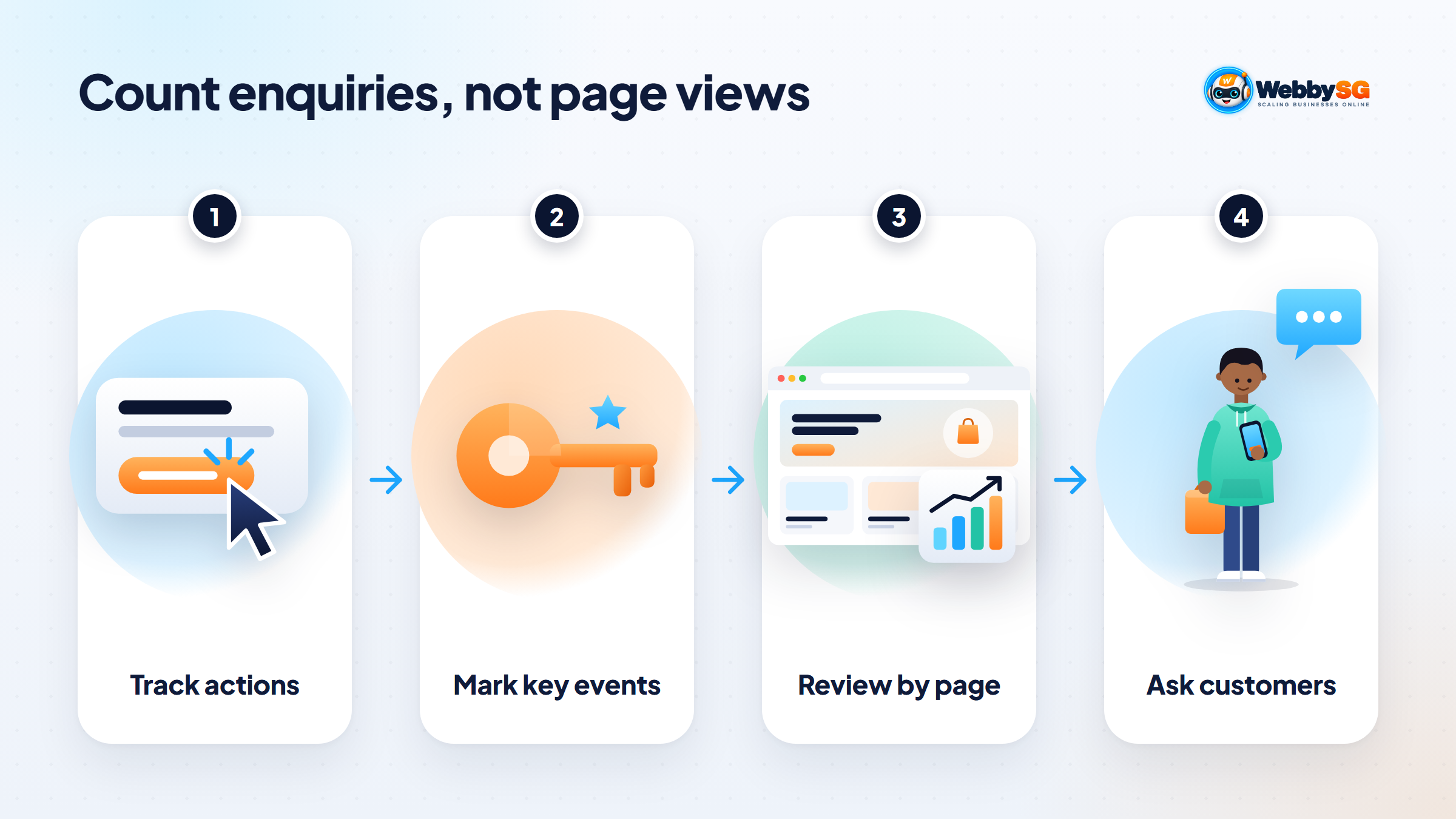
Six months in, someone will ask whether the articles are worth the time. You want to answer with numbers, so set this up once, before the first piece goes live:
- Track enquiry actions as events. Google's list of GA4 recommended events includes generate_lead for form submissions. Track WhatsApp and phone clicks as events too.
- Mark them as key events. GA4 now calls important actions "key events" rather than conversions. Google explains how to mark events as key events in the Admin area.
- Review by landing page. Each month, check which pages people first landed on before completing a key event.
- Connect Search Console to see which queries bring visitors to each page.
- Ask new customers how they found you, and note when they mention a specific guide.
What to outsource and what to keep in-house
| Keep in-house | Can be outsourced |
|---|---|
| Customer questions and objections | Keyword and competitor research |
| Prices, processes and expert knowledge | Drafting and editing articles |
| Final fact check and approval | Design, photography and video editing |
| Real project photos and customer permissions | Technical SEO, publishing and GA4 set-up |
Webby SG's SEO service includes human-edited blog articles, service page optimisation, Google Business Profile posts and monthly reporting. If you would like help turning your customer questions into a content plan, get in touch.
Frequently asked questions
How long does content marketing take to show results?
Usually months rather than weeks. New pages take time to be crawled, indexed and trusted, and competitive topics take longer. Improvements to existing service pages often show results sooner than new blog posts. Judge progress over six months, using Search Console impressions and GA4 key events.
How much content should a small business publish each month?
There is no official number. As Webby guidance, two to four substantial pieces a month suits most small teams, including refreshes of older pages. One genuinely useful piece is worth more than several thin ones.
What is the 70/20/10 rule in content marketing?
It is a planning rule of thumb, not a standard. One version spends about 70% of effort on proven content types, 20% on variations of what works and 10% on experiments. Another, borrowed from social media, splits content into 70% useful, 20% shared and 10% promotional.
Is content marketing worth it for B2B SMEs in Singapore?
Often, yes, because B2B buyers research before contacting suppliers and frequently involve several decision-makers. Guides that explain costs, processes and comparisons help them build a case internally. It works best when each guide links to a clear service page and enquiries are tracked.
Can I use AI to write my content?
You can use AI tools to research, outline and draft, but Google warns that producing large volumes of text without manual oversight adds little value. Have someone with real knowledge check facts, add local detail and experience, and edit before publishing. Your own prices, projects and expertise are what make the content worth reading.