Content Repurposing Review: Preserve Meaning Across Formats
Repurpose an identified content version for one reader question. Preserve conditions, verify freshness and asset permission, and review the finished derivative.
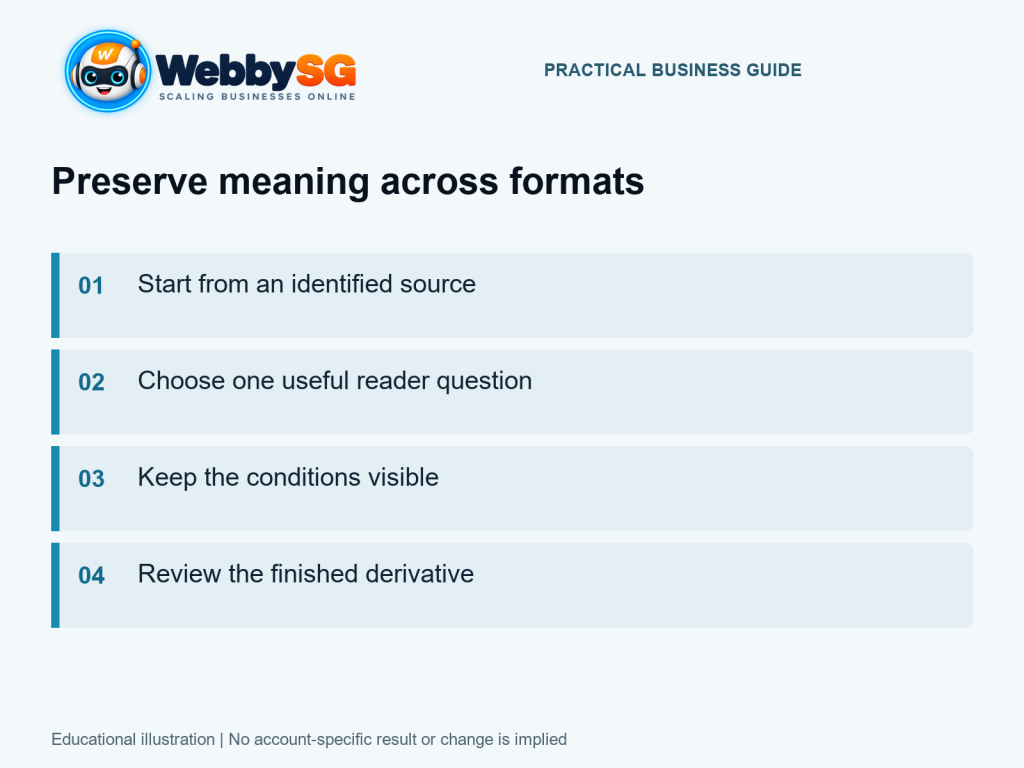
What makes a content repurposing review useful?
A content repurposing review checklist should start from an identified source version, select one reader question and adapt the explanation for the new format without strengthening its claims. Preserve important conditions, verify any time-sensitive detail and confirm permission for the assets being reused. An article's approval does not automatically approve every shortened post, graphic or advertisement derived from it.
A long guide can support several smaller pieces, but cutting paragraphs into shorter blocks is not enough. A reader seeing only a social image may never see the qualification in the original article. Repurposing therefore involves deciding what meaning must travel with the extract.
Webby's blog writing guide provides the original-article context, while its social media marketing information describes another distribution setting. This guide connects those settings through an editorial review method, without claiming a performance result.
Identify the source that is actually being reused
Keep the source URL or file, version and relevant approval record together. If the article has changed, establish which wording is current before creating another derivative. A saved screenshot may preserve an older offer or an earlier conclusion.
Read the section in context. A sentence beginning “in this example” depends on the example around it. Removing that context can turn a hypothetical explanation into what looks like a claim about the business.
Google's helpful content guidance emphasises useful original value rather than simple rewriting. For repurposing, that suggests adapting the explanation to a real question in the new format instead of merely changing words.
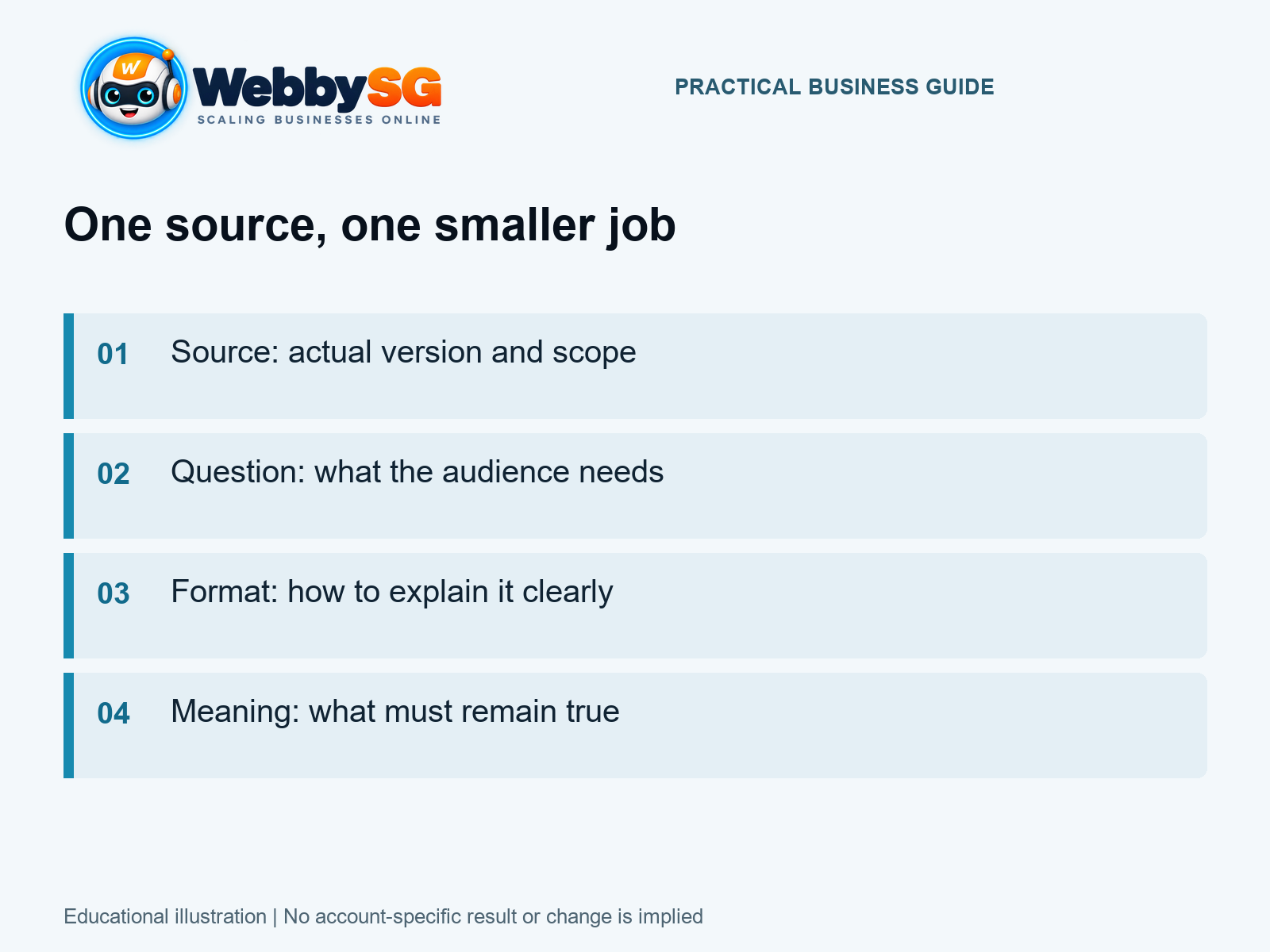
Choose one job for the new piece
Decide what the audience should understand after seeing it. A comparison graphic might clarify two options; a short post might explain one common misunderstanding; a video might demonstrate a sequence. Different jobs need different selections from the source.
For an educational example, an article about reviewing a supplier quotation could become a diagram distinguishing price, scope and assumptions. It need not become a smaller version of every section. The new piece has value when it resolves that single distinction clearly.
Do not force the same message into every format merely to fill a calendar. If the subject requires important detail that cannot fit legibly, choose a format that accommodates the explanation or select a narrower question.
| New format | Useful adaptation | What must survive |
|---|---|---|
| Single graphic | One clear distinction. | The condition that prevents misreading. |
| Short text post | One practical question and explanation. | The source's actual scope. |
| Brief video | A visible sequence or decision. | Meaning in captions and narration. |
| Advertisement | An approved offer or message. | Support for the exact claim and destination. |
Preserve the conditions that change the answer
Read which words limit the original statement: selected products, a particular date, an illustrative situation or a condition requiring confirmation. Those words may be less visually exciting than the headline, but removing them can change the message.
A short piece can simplify an explanation while retaining its boundary. For example, a comparison can say that contract terms determine an option rather than declaring one option universally cheaper. Brevity is useful when the meaning remains accurate.
Review the finished headline and image together. If a cautious caption sits below an absolute claim in large type, the audience may receive the absolute message. The qualification should be visible where it affects interpretation.
Recheck freshness and asset permission
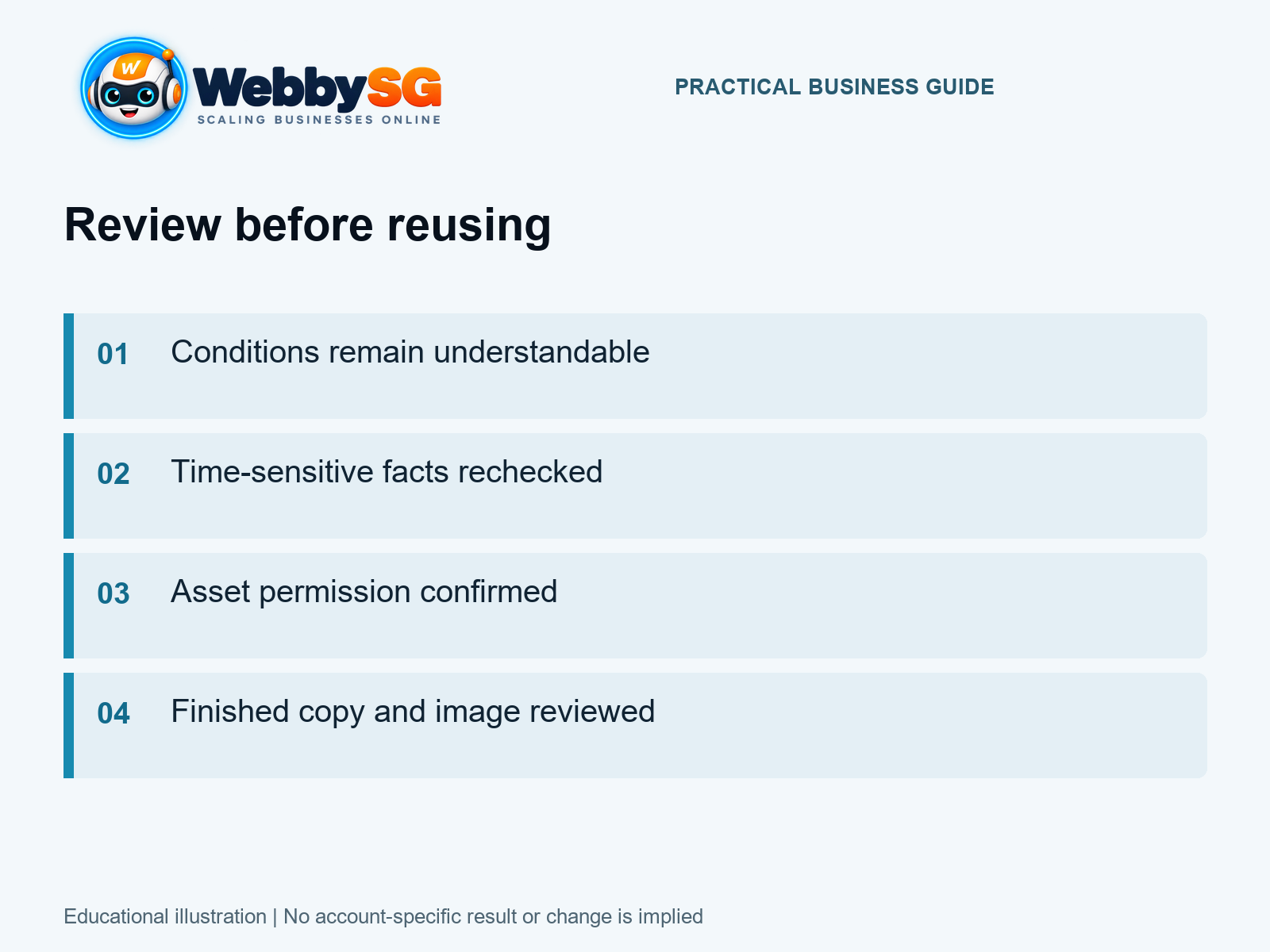
Confirm time-sensitive information such as availability, pricing, dates and platform behaviour before reuse. The source's original publication date does not establish that every detail remains current when the derivative is prepared.
Identify whether the business has permission to reuse the selected photograph, quotation, logo or recording in the intended context. The fact that an asset appears in one article should prompt a permission check, not an assumption about every channel or commercial use.
This is a practical review question, not a legal determination of rights. If permission is unclear, use an authorised alternative or obtain the appropriate clarification before the asset enters the finished piece.
Adapt the audience and destination together
A reader arriving from a short social explanation may need a different introduction from someone already reading the full guide. Ensure the link destination answers the promise made by the extract and is still the intended current page.
Where paid distribution is considered, Webby's social advertising information supplies the channel context. Advertising is a separate decision about message, audience, destination and authorised spend; a repurposing plan does not activate it.
Keep the business's actual audience central. A technical explanation for procurement teams should not become a consumer how-to merely because that format is easier to produce. The source's commercial context remains relevant.
Review each derivative as a finished piece
Give the reviewer the final copy, artwork and destination together. A text-only approval cannot reveal whether a graphic clipped a condition or made a number dominate the wrong comparison.
If a reviewer changes the meaning, reconcile that edit against the source. The derivative should not quietly become the only place where a stronger promise appears. Resolve the claim first, then produce the final format.
Keep the relationship visible after release
Retain the source version and derivative identities in the content record. If a factual correction becomes necessary, the business can identify related pieces without searching every folder or relying on a creator's memory.
Measure the new piece according to its actual purpose and available evidence. Reusing an article does not guarantee reach, enquiries or sales. A clear explanation and a verified publication record are distinct from a commercial outcome.
Compare the extract with the source one last time
Read the derivative without the article open, then return to the source. Ask whether a person seeing only the smaller piece would understand the same condition and example status. This catches a common editorial problem: the creator remembers information the audience cannot see. Add the necessary context, narrow the claim or choose another extract when the meaning depends on invisible background.
Repurposing questions
Is repurposing just shortening an article?
No. Choose the new reader question and preserve the conditions that affect the answer.
Does source approval cover every derivative?
The finished derivative can change meaning or presentation and needs its own appropriate review.
Can an old product detail be reused unchanged?
Check its current accuracy before reuse, particularly availability, price and time-sensitive conditions.
Why retain source versions?
They make later corrections and derivative review traceable to the actual original evidence.