Marketing Content Fact-Checking: Claims, Sources and Scope
Check marketing claims against suitable sources and business confirmation. Review scope, conditions, images and changed wording before final content approval.
How should a business fact-check marketing content?
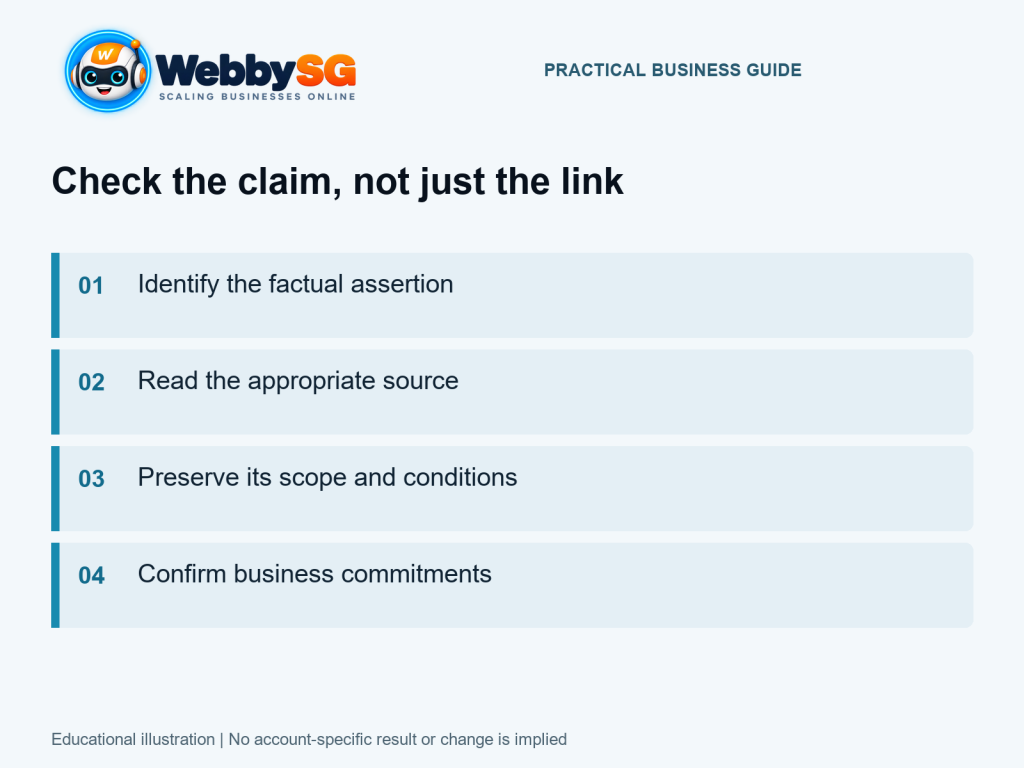
A marketing content fact-checking workflow should check each meaningful factual claim against an appropriate source, then confirm that the wording preserves its scope and conditions. Give business facts to someone authorised to confirm them and technical claims to the relevant current primary source. A fluent sentence, a source link or an approval comment does not by itself establish that the claim is true.
Content review often stalls because “please check the article” mixes factual verification, style preferences and publication approval. A fact-checking workflow gives the reviewer a smaller, more useful question: which statements need evidence, and does the exact wording say only what that evidence supports?
Webby's blog writing guide provides the content-production context. This article explains an editorial method for businesses reviewing copy. It is not a legal compliance assessment or a claim that every statement on an existing site has already passed such a review.
Identify claims that could change a reader's decision
Start with prices, availability, service scope, product properties, deadlines, qualifications and outcomes. These statements can materially affect what a reader expects. A headline and image caption can make such a claim just as easily as a paragraph.
Separate a factual assertion from an optional creative suggestion. “Use blue as an accent” is a design choice; “this material is child-safe” is a property claim requiring appropriate support. Treating both as ordinary copy editing can leave the more consequential assertion unchecked.
Google's people-first content guidance asks creators to evaluate accuracy, sourcing and original value. An editorial claim review puts those questions into a practical business process without promising a ranking result.
| Claim type | Appropriate starting evidence | Common review mistake |
|---|---|---|
| Business commitment | Current authorised business confirmation. | Copying an old offer as if it still applies. |
| Platform behaviour | Current official documentation. | Generalising from an unrelated tutorial. |
| Measured result | The actual dated measurement and scope. | Turning correlation into a guarantee. |
| Product detail | The exact current product information. | Borrowing a property from a similar item. |
Match the source to the exact statement
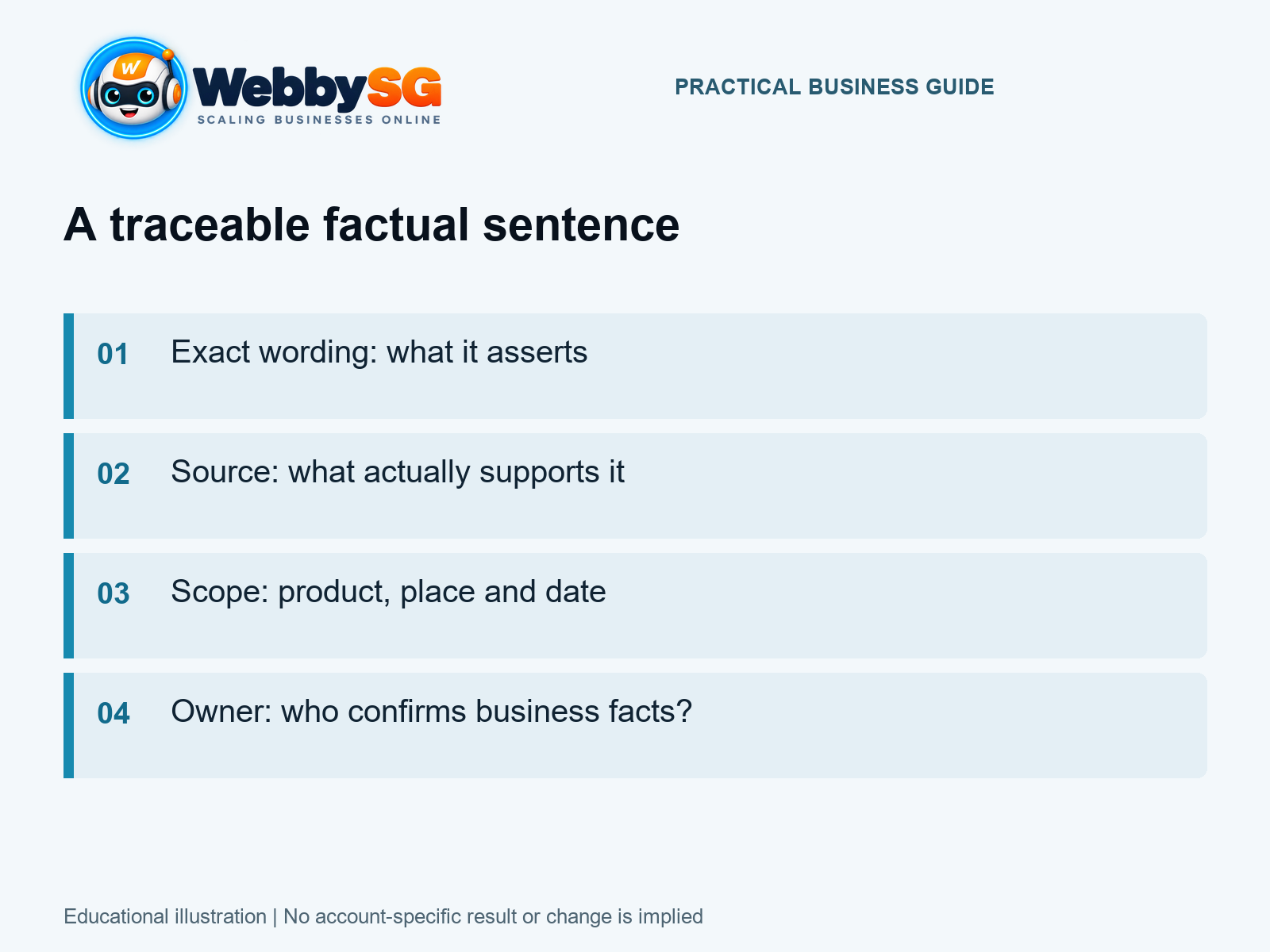
A source can be authoritative yet fail to support the sentence beside it. Read whether the statement concerns the same product, country, period and customer group. A general explanation of a service does not establish a particular provider's price or delivery commitment.
For an educational example, a supplier page might say a feature is available on selected models. Removing “selected” changes the claim. Linking to the original page does not repair the broader wording.
Record the source and when it was checked, particularly for details likely to change. The date establishes the observation's freshness; it does not guarantee that the statement remains current indefinitely.
Give business facts a named decision maker
The agency can research and draft the copy, but some facts belong to the business. Service boundaries, current offers and delivery commitments should be confirmed by someone authorised to speak for that business.
Ask a specific question with the proposed wording attached. “Does this response commitment apply to the service described here?” is more answerable than asking someone to invent the whole article. Preserve any conditions supplied in the answer.
Webby's company information supplies its published agency context. A generic content process should not invent a team credential, client result or company commitment to make an article appear more persuasive.
Choose between correction, qualification and omission
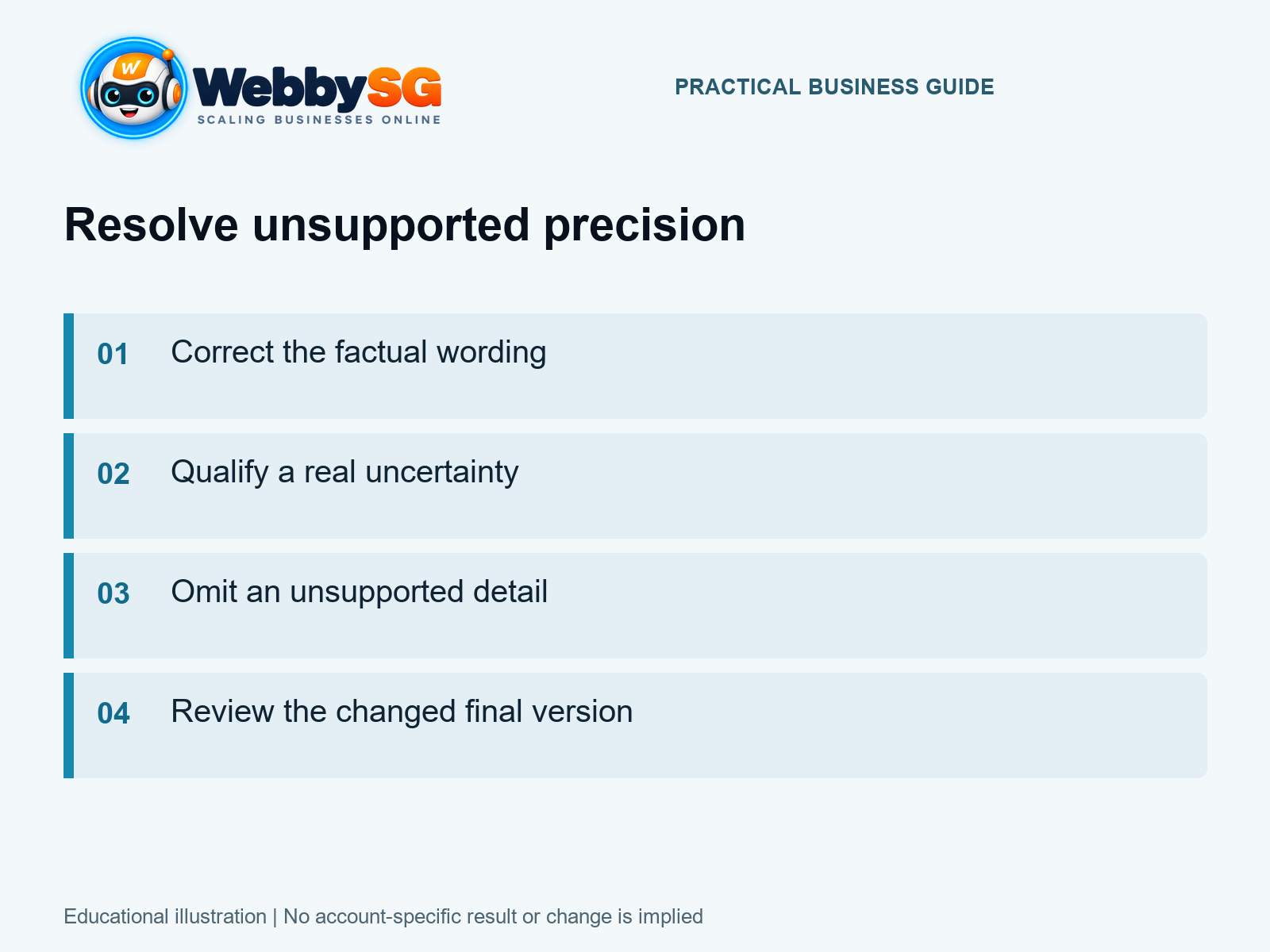
If the source supports a narrower statement, revise the sentence to that scope. If the detail remains uncertain but the uncertainty itself helps the reader, explain what must be checked. If the statement adds little without unsupported precision, remove it.
Do not retain an invented figure merely by labelling it an example when the surrounding text presents it as the company's actual price or result. Educational examples must be unmistakably hypothetical and should not imply an unavailable offer.
A useful article can explain the decision without a fabricated case study. Describe how to compare evidence, which conditions matter and what would change the choice. Missing proof is a reason to reshape the section, not manufacture a convincing story.
Review images and summaries as factual content
A diagram may accidentally turn a cautious paragraph into an absolute promise. Check its labels and captions against the same source. A product image should represent the actual item where the article depends on that identity.
Review the title, description and social summary too. If the body explains that a result depends on conditions, the summary should not advertise a guaranteed outcome. The reader should receive a consistent factual message across the article's surfaces.
For multilingual content, review meaning rather than word count alone. A translation can strengthen a promise or remove a condition even when it appears shorter and clearer. Use an appropriate reviewer for the actual language and subject.
Recheck changes after the factual pass
A later stylistic edit can alter a verified claim. Keep the checked version identifiable, and return material changes to the relevant reviewer. Approval of one sentence should not be assumed to cover a stronger replacement.
Where the content will also support advertising, consider the exact message used there separately. Webby's social advertising information provides that channel context. A shortened advertisement still needs support for its own wording and scope.
Deliver a useful factual review
Return confirmed statements, exact corrections and unresolved questions with their owners. Keep style preferences in a separate part of the feedback so a writer can see which changes concern truth and which concern presentation.
The result should help the business make a concrete approval decision. A long list of links is less useful than a clear explanation of what each important source supports and what it leaves unknown.
Content fact-checking questions
Does adding a citation make a claim verified?
No. The source must support the exact claim, including its conditions and scope.
Who should confirm a company's service commitment?
Someone authorised by that business, reviewing the actual proposed wording.
Can an unsupported result be kept as an example?
It must not appear to be a real company outcome. Often a decision explanation is more useful.
Do images and metadata need checking?
Yes. Their labels and summaries can create factual promises independently of the body.