
GA4 Lead Form Event Verification: What a Test Proves
Verify a lead form’s intended event, analytics destination and enquiry delivery separately. Review success, failure and repeat cases without assuming lead quality.
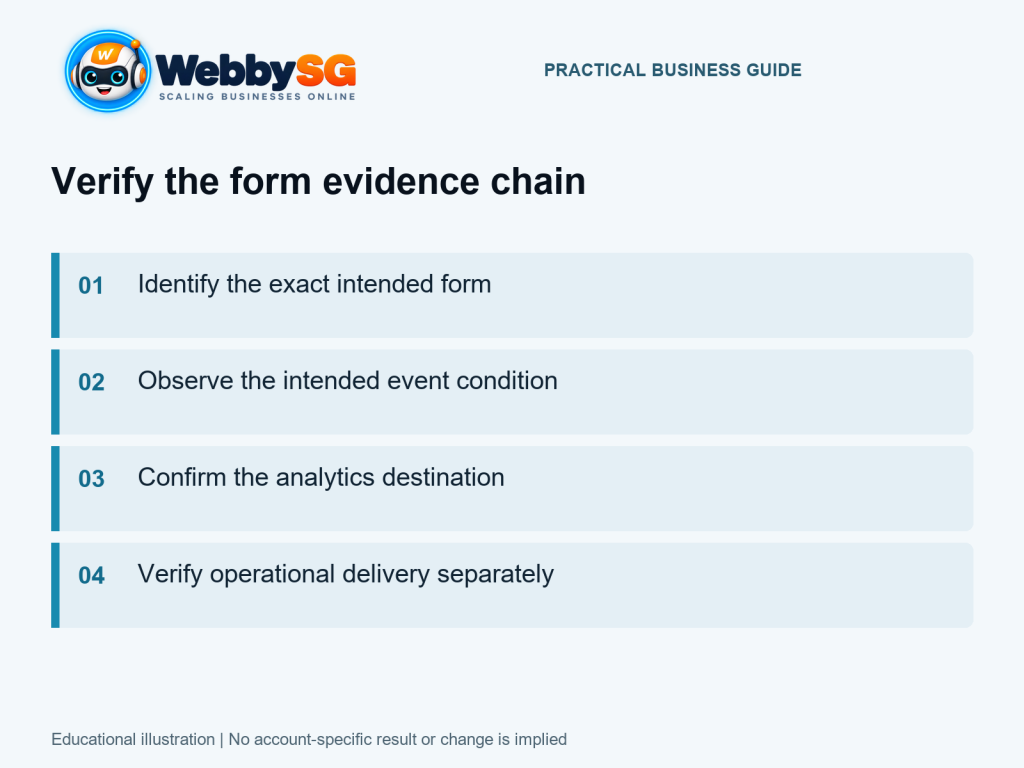
What does GA4 lead form event verification need to prove?
Verify the intended form, the condition that produces the event, the correct analytics destination and the operational delivery separately. Opening a form, attempting submission, displaying a success message and receiving an enquiry are different observations. A recorded event is useful only when its meaning is understood and the relevant failure cases have been checked.
A website can contain a measurement tag while a business remains unsure whether genuine enquiries are recorded or delivered. The useful question is not simply whether “analytics is installed.” It is what happened during a controlled journey, what was observed and what each observation establishes.
Webby's SEM service information provides the advertising context. This guide concerns verifying a form measurement definition; it does not claim that Webby's or any reader's tracking is configured, nor prescribe a universal implementation snippet.
Identify the exact form and intended outcome
Start with the page, form and business purpose. A newsletter signup, job application and service enquiry may share visual styling while representing different actions. Measuring every form under the same label can hide those differences.
Agree the condition the event is intended to represent. “User interacted with a form” and “the service enquiry was accepted by the website” answer different questions. The person handling the enquiries should understand the chosen definition.
Google's lead-form key event guide illustrates narrowing a general form event to a specific form before marking it as a key event. Its example is an explanation of that distinction, not proof that every form implementation behaves identically.
Separate the evidence chain
| Observation | What it can establish | What still needs checking |
|---|---|---|
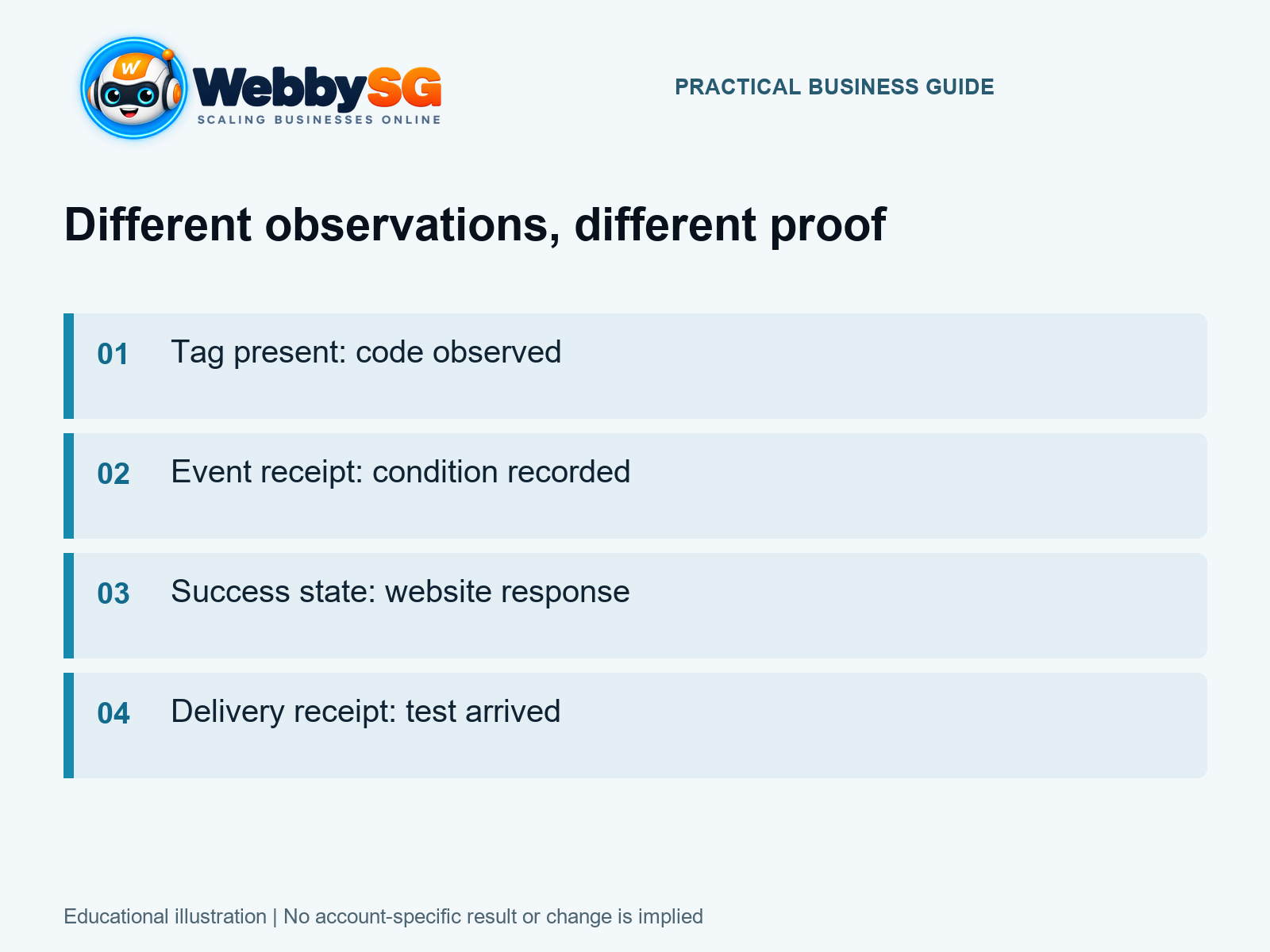
| Page contains a tag | Measurement code is present in that observation. | Correct destination and event behaviour. |
| Event is observed | A condition produced a measurement record. | Whether it represents the intended successful action. |
| Success message appears | The website displayed that state. | Actual operational delivery. |
| Test enquiry arrives | The tested route delivered that submission. | Other routes and ongoing reliability. |
No single row completes the whole chain. A concise verification record should state which observations were made rather than replacing them with one broad “working” label.
Prepare a controlled test
Agree the test with the person responsible for the website and the receiving system. Use an identifiable test message and an appropriate test contact, so the submission is not later treated as a new customer opportunity.
Record the page, time and expected behaviour. Establish who can inspect the intended analytics destination and who can confirm delivery. Access to one system does not imply access to the other.
For a Singapore business using local reporting dates, keep the time zone explicit in the internal test record. A date observed in another reporting setting should not be silently treated as the same local period. This is a coordination choice, not an instruction to alter account settings.
Include attempts that should not count as success
Test the ordinary successful journey, then examine relevant failure cases with the implementation owner. Does opening the form create the same event? What happens when validation fails? Can revisiting a confirmation page produce another record?
The exact checks depend on the website. A form using a separate confirmation page may behave differently from one that displays an inline message. Do not copy a test outcome from one form into the acceptance record for another.
When a failure case produces the success event, describe the observed condition precisely. The correction should address that condition. Changing the event name alone does not change what the implementation records.
Check the analytics destination and report interpretation
Confirm the account, property and relevant stream or destination with someone who has authorised access. A tag identifier seen in website markup is a useful clue, but it does not prove the reviewer is examining the intended property.
Then establish where the event can be inspected and what the selected report measures. A diagnostic view and an aggregated business report serve different purposes. Record the view actually used for the test rather than implying every report was checked.
Webby's campaign reporting guide explains why campaign figures need clear definitions. The same principle applies before a form event is interpreted as an advertising conversion or a business lead.
Verify delivery without exposing unnecessary information
Ask the authorised recipient to confirm receipt of the identifiable test through the intended route. A visible success message should not substitute for that confirmation. If the enquiry is routed to more than one place, establish which routes are actually within the test.
Keep private message content and personal details out of a broad marketing worksheet. The test record can describe the result and evidence location without copying sensitive data into every review document.
If delivery fails while the event records, there are two findings: measurement was observed and operational delivery did not complete. Report both. Calling the whole journey successful would conceal the failure the business most needs to understand.
Keep business qualification separate
An actual delivered enquiry still requires business review. It may be a duplicate, an unrelated request or a suitable prospect. Measurement verification cannot decide that from the event alone.
Webby's company information provides the agency context without replacing that operational judgement. Finish the technical review with the exact journey checked, any corrective action and the questions still requiring the business's confirmation.
Explain a partial pass usefully
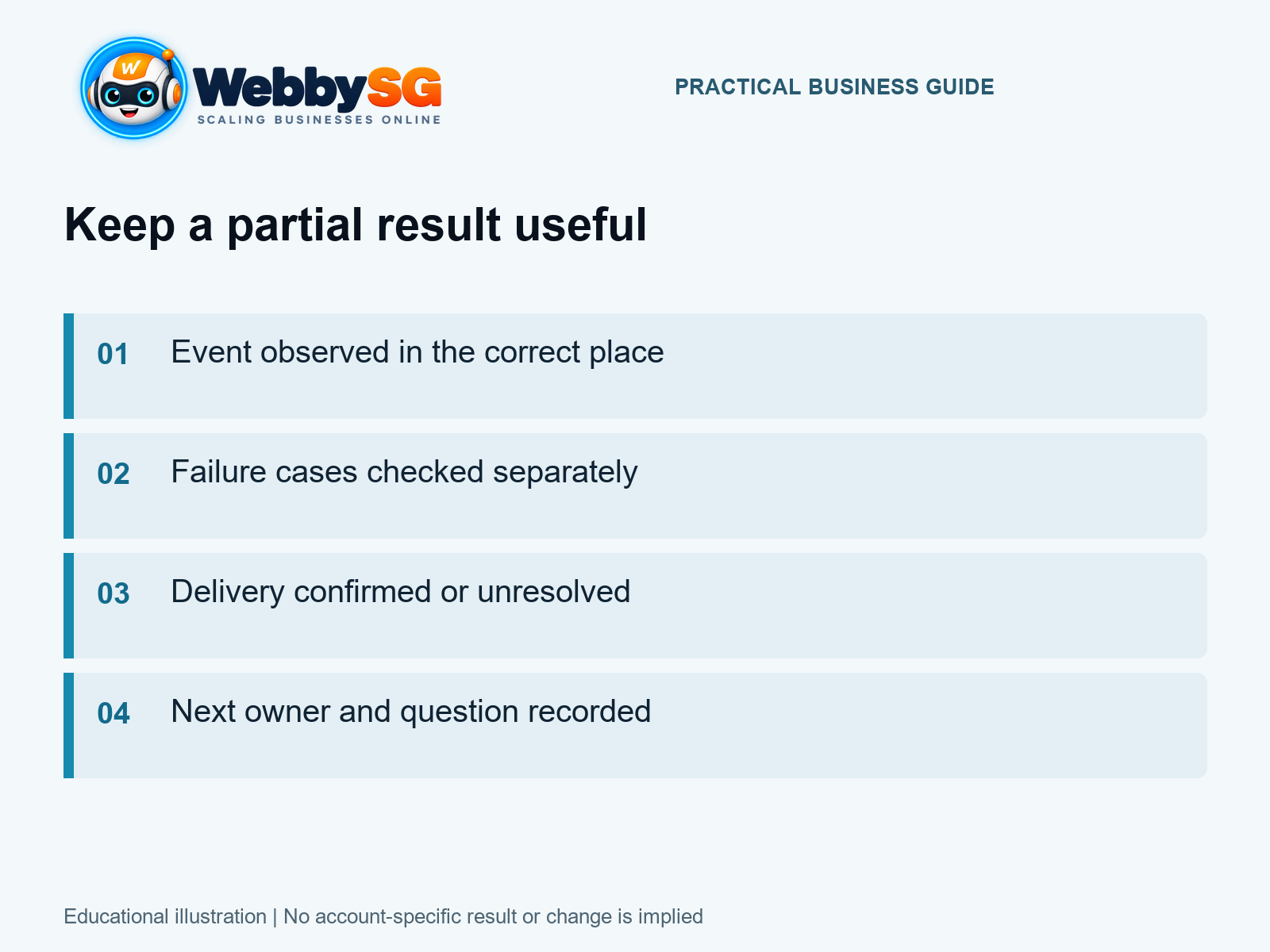
A reviewer might confirm the intended event in the correct property while the receiving team cannot find the test message. The useful conclusion is not that the test was broadly successful or broadly useless. Record the event receipt as observed, the delivery check as failed or unresolved, and the person investigating that route. Preserve the test identifier internally so the next person can continue the same investigation rather than creating unexplained duplicate test submissions.
Form event questions
Does a visible tag prove form tracking works?
No. Event behaviour, destination and delivery require separate observations.
Should every form be one key event?
Establish the intended business action and actual form distinctions before choosing a configuration.
Does the success message prove the enquiry arrived?
No. Verify receipt through the intended operational route.
Can a test submission be counted as a genuine lead?
It should remain identifiable as test activity and separate from verified customer opportunities.