
Blog Writing Services in Singapore: What to Expect
Blog writing services in Singapore: what a good service includes, how the process works, what you must supply, and how to compare agencies and freelancers.

Blog writing services in Singapore range from a freelancer who writes to a topic you send, to an agency that plans the topics, researches them, writes, optimises and publishes the posts for you. Both can work. What matters is whether each post answers a question your buyers actually ask, and whether it helps them find the service you sell. This guide covers what a good blog writing service includes, how the process works, what your business still has to supply, and how to compare providers before you sign.
Blog writing services plan, research, write, optimise and publish articles for your website. For a Singapore business, a good service starts from the questions your buyers ask, links each post to a service page, uses your own expertise and facts, and reports on rankings and enquiries rather than the number of posts delivered.
What blog writing services include
A blog writing service is more than the writing. The words are usually the smallest part of the work. When you compare quotes, check which of these are included and which you would have to do yourself.
Topic planning
A list of articles chosen for a reason: questions buyers ask before they choose, such as cost questions, comparison questions and how-to questions. Each topic should connect to something you sell. A plan that is just a list of popular keywords, with no link to your services, tends to bring readers who never enquire.
Research and briefs
Before writing, someone should look at what already ranks for the topic, what those pages cover, and what they leave out. The result is a brief: the angle, the headings, the questions to answer and the page the article should link to. A post written without a brief usually repeats what is already on page one.
Writing and editing
Plain, accurate writing in your brand's voice, with short paragraphs and headings a reader can scan. Editing should cover facts as well as grammar. In a technical or regulated industry, ask who checks the facts and how.
On-page SEO
A title and meta description that describe the page honestly, one clear target search per article, headings that follow what the reader wants to know, image alt text, and schema markup where it fits. This is what lets search engines understand the page.
Publishing and internal links
Some providers deliver a document and stop. Others publish to your website, add images, and link each post to the relevant service page and to related articles. Internal links are how a blog supports the pages that bring enquiries, so check who adds them.
Refreshing older posts
Articles age. Prices change, rules change, and a competitor publishes something more useful. A good service revisits posts that have slipped rather than only adding new ones.
When a blog is not the first thing to fix
A blog supports your service pages. It rarely replaces them. If a service page says three sentences about what you do, adding articles that link to it will not make it convincing. Buyers who arrive still find a thin page, and search engines still see little reason to rank it.
Before paying for articles, check that:
- each main service has its own page that explains what is included, who it is for and how the work is done;
- Google can crawl and index your site, and your pages load quickly on a phone;
- your site has the core pages a business website needs, such as about, services and contact;
- you can see where enquiries come from, so you will know if the blog is helping.
If those are in place, a blog can do its real job: answering questions buyers ask earlier in their decision and sending them to the right page.
How the blog writing process works
Most blog writing services follow a similar sequence. The names differ, but the steps below are what to expect, and what to ask about if a provider skips one.
- Plan topics. Agree a list of articles tied to your services and your buyers' questions, in a sensible order.
- Research and brief. Study what ranks now, find the gaps, and write a brief for each article.
- Write and edit. Draft the article, check the facts with you, and edit for clarity and voice.
- Optimise and publish. Add the title, meta description, headings, images, schema and internal links, then publish.
- Measure and refresh. Track rankings, traffic and enquiries, and update posts that need it.
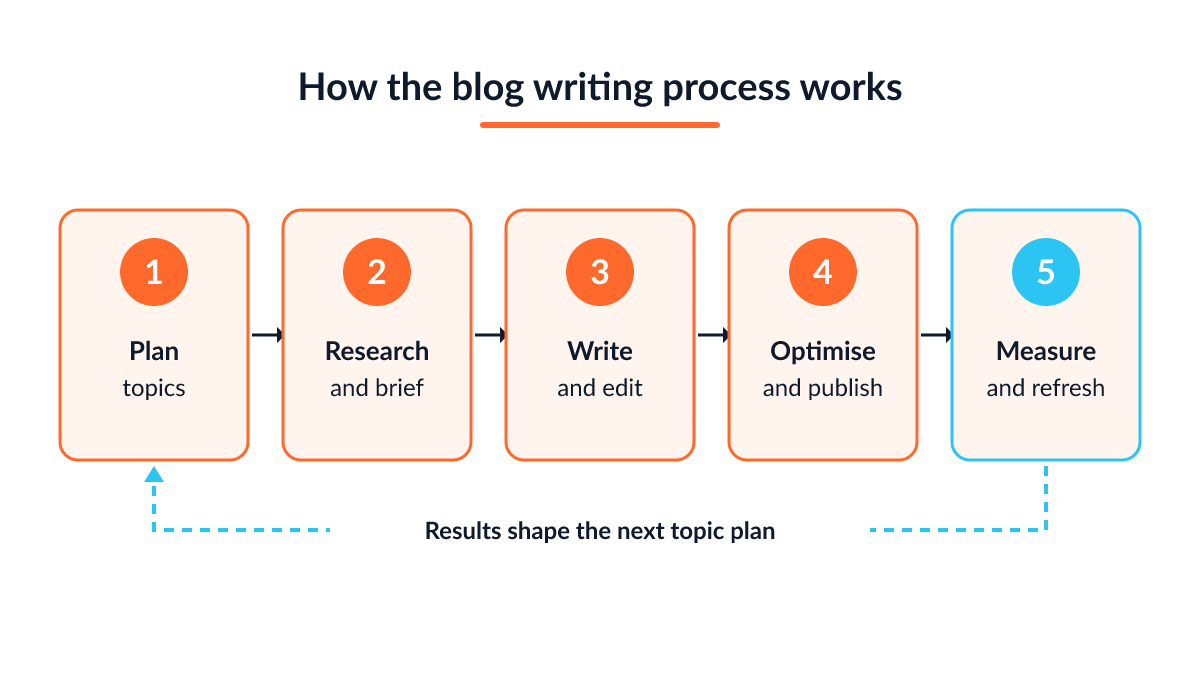
The last step matters most and is the one most often left out. Without it, you cannot tell which topics are worth more of your budget.
What your business still needs to supply
A writer can research a topic, but only your business knows your prices, your process, the questions customers ask on the phone, and the mistakes you see people make. That knowledge is what makes an article worth reading, and it is what search engines look for when they judge experience and expertise.
Expect a good provider to ask you for:
- the questions customers ask most often before they buy;
- facts only you can confirm, such as what is included in a service and how long the work takes;
- a short review of each draft by someone who knows the subject;
- approval before anything is published.
This matters more now that AI tools can produce generic articles in seconds. A post that anyone could have written adds little. Tools can help with drafts, as covered in our guide to using ChatGPT for marketing and web content, but the useful parts of an article come from real knowledge of the business.
Agency, freelancer or in-house writer
There is no single right choice. It depends on your budget, how technical your subject is, and how much of the work you want to manage yourself.
| Option | Suits you if | Watch out for |
|---|---|---|
| Freelance writer | You already have a topic plan and can handle SEO, images and publishing yourself | Strategy, research and publishing may not be included; quality depends on one person |
| Agency blog service | You want topics, research, writing, optimisation and publishing handled together | Package quotas that reward volume over usefulness; check who writes and who checks facts |
| Blog writing inside an SEO retainer | You want articles planned around the same goals as the rest of your SEO work | Make sure the retainer states how many articles, or which pages, are included |
| In-house writer | You publish often and your subject needs deep product knowledge | SEO skills and a topic plan still have to come from somewhere |
If you are weighing a full SEO retainer against paying for articles alone, it helps to compare what SEO packages include first, since many already cover content.
How to choose blog writing services in Singapore
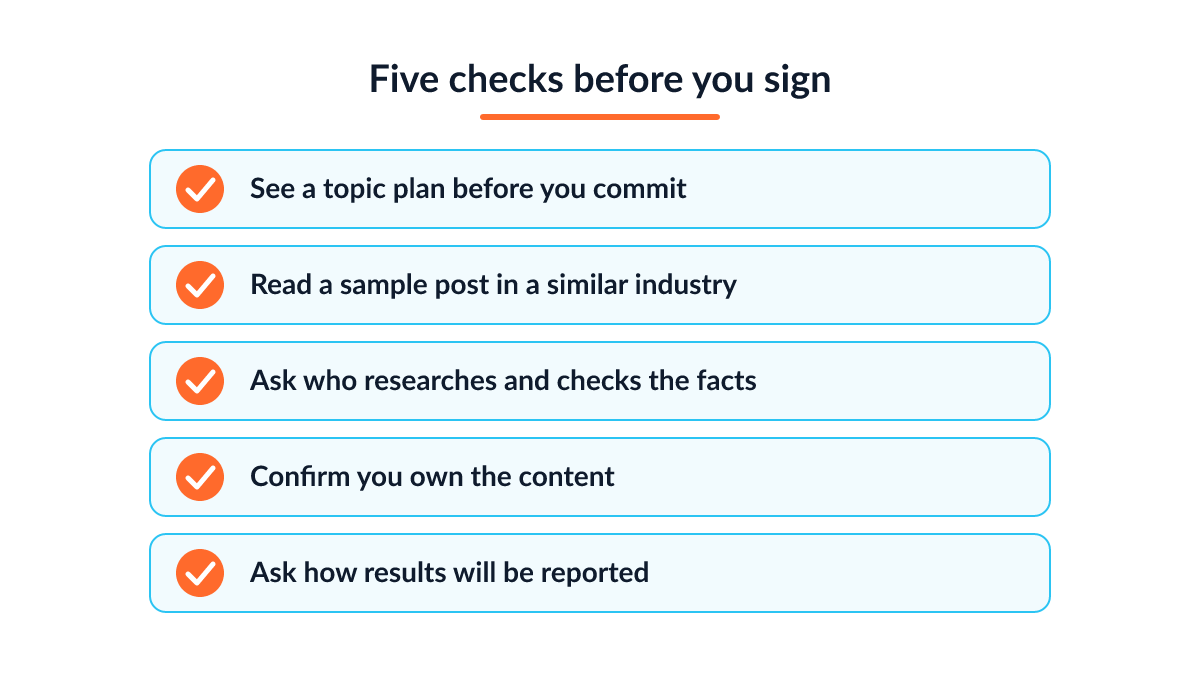
Whoever you are comparing, the same questions separate a useful service from one that simply delivers word counts.
- Can you see a topic plan before you commit? It shows whether they understand what you sell and who buys it.
- Can you read a sample post in a similar industry? Check it for facts, clarity and whether it links to a service page.
- Who does the research, and who checks the facts? Especially important in finance, health, legal or technical fields.
- Who owns the content? It should be yours, published on your own domain.
- How will results be reported? Look for rankings, traffic and enquiries, not only a count of articles delivered.
Be careful with promises of guaranteed rankings, fixed article quotas with no topic plan, and content that stays on the provider's platform. Our guide to choosing an SEO agency in Singapore covers more of these warning signs.
How to tell if your blog is working
A blog is working when it brings the right people to your site and some of them take the next step. Useful measures include:
- the searches each post ranks for, and whether those searches match what you sell;
- visits from search to each post, tracked over months rather than weeks;
- clicks from posts to service pages;
- enquiries that started on a blog post.
Posts written with clear answers near the top are also more likely to be quoted by AI search tools, which is covered in our guide to answer engine optimisation. Treat that as a bonus, not a replacement for enquiries.
How Webby SG approaches blog writing
At Webby SG, blog writing is part of our SEO service rather than a separate package. Each piece of content is chosen for its ranking opportunity: an article, a new service page, or a refresh of an existing one. We plan articles around the cost, comparison and how-to questions buyers ask before they choose, and each one is meant to support a service page. We do not publish to meet an article quota. Monthly SEO runs from S$500 to S$1,200 a month, month to month, with a plain-English report each month on what was done and what moved.
Frequently asked questions
How much do blog writing services cost in Singapore?
It depends on what is included: article length, how much research is needed, whether strategy, images and publishing are part of the work, and how technical your industry is. Ask each provider for a per-article scope and compare that, not only the price. At Webby SG, articles are part of monthly SEO, which runs from S$500 to S$1,200 a month.
Can AI write my blog posts?
AI tools can help with outlines and first drafts, but they cannot supply your experience, your prices or your customers' real questions, and they can state wrong facts confidently. Google's published guidance judges content on whether it helps people, not on how it was produced. Whoever writes your posts, a person with real knowledge should check every fact before it goes live.
How often should a business publish blog posts?
There is no fixed number that works for every business. A steady schedule you can keep, with each post answering a real buyer question, is worth more than a burst of posts followed by months of silence. Publishing volume for its own sake does nothing for rankings or enquiries, so set the pace by the topics worth covering.
Who owns the blog content once it is written?
You should. Confirm in writing that the articles, images and any drafts belong to your business, and that they are published on your own website and domain. Ask what happens to the content if you stop working with the provider. If the answer involves removing articles or paying to keep them, treat that as a warning sign.
Do blog posts help with AI search tools like ChatGPT?
They can. AI answer tools tend to quote pages that answer a question directly and clearly, with structured headings, short answer paragraphs and accurate facts. The same qualities help readers and Google. A blog written around your buyers' questions gives these tools something specific about your business to cite.
Blog writing services in Singapore: the short version
Good blog writing services in Singapore start from your buyers' questions, tie every post to something you sell, use your own knowledge and facts, and report on rankings and enquiries. Fix thin service pages first, ask to see a topic plan and a sample, confirm you own the content, and judge the work on the enquiries it brings rather than the number of posts delivered.