
Domain SG Registration: Register a .sg Domain
Domain SG registration explained step by step: choose an extension and registrar, verify ownership, connect DNS, and keep renewals under company control.

Domain SG registration is straightforward when the ownership details are decided before checkout. The important part is not only securing an available name. It is making sure the correct person or company is the registrant, completing Singapore’s identity-verification step, and keeping renewal and DNS access under business control.
For domain SG registration, choose an SGNIC-accredited registrar, confirm the name is available, enter the registrant and local administrative contact details, pay the registrar, then complete VerifiedID@SG using Singpass or Corppass. Keep the registration in your own name and record the renewal, DNS and login access details.
Choose the right .sg extension first
A domain ending in .sg signals a Singapore connection, but not every ending serves the same type of registrant. SGNIC publishes the current .SG category and eligibility rules. Read the rule for your chosen ending before buying, especially if the registrant is overseas or the name is for an organisation, school or network provider.
| Extension | Usually considered by | What to check |
|---|---|---|
| .sg | Businesses, organisations and individuals wanting the shorter Singapore ending | Administrative contact and VerifiedID@SG requirements |
| .com.sg | Commercial entities with an eligible Singapore registration or professional-body connection | Entity details and the current category criteria |
| .org.sg | Eligible societies, community bodies, places of worship, embassies and certain organisations | The organisation’s qualifying registration |
| .edu.sg | Eligible educational institutions and training providers | The education-related eligibility rules |
For many Singapore SMEs, the practical choice is between .sg and .com.sg. Pick the version that matches the registrant and the brand, not simply the cheapest promotion shown at checkout.
Prepare these details before registration
Gather the following before opening a registrar checkout. Doing this first prevents a domain from ending up in a staff member’s or supplier’s personal registrar profile.
- The legal registrant: the person or entity that should own the domain.
- An administrative contact: the person or organisation responsible for confirming the registrant details.
- A company-controlled email address: use an address the business can keep even when staff or suppliers change.
- The exact domain spelling: check singular and plural forms, hyphens, abbreviations and likely typing mistakes.
- A payment method and renewal owner: decide who receives renewal notices and who is accountable for payment.
- Your intended website and email setup: know whether the domain must point to a website, business email or both.
Domain SG registration: the step-by-step process
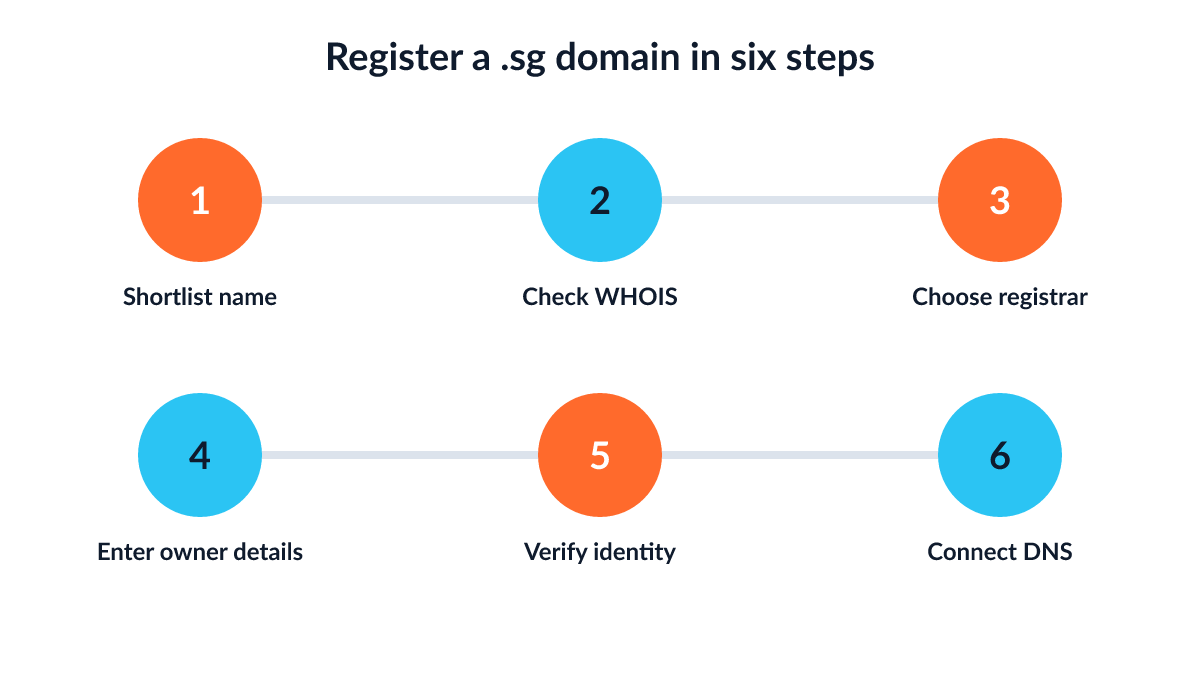
1. Shortlist a clear, defensible name
Start with a name that people can spell after hearing it once. A company name, product name or short descriptive phrase is usually easier to remember than a string of keywords. Avoid a name that could be confused with another business or protected brand. Availability is not the same as a legal right to use a name.
2. Check availability through SGNIC WHOIS
Use the WHOIS search on the SGNIC website. SGNIC states that a “Domain Not Found” result means the name is available to register, subject to the applicant meeting the relevant criteria. Check the exact extension you want, because example.sg and example.com.sg are separate registrations.
3. Choose an SGNIC-accredited registrar
SGNIC operates the registry, while accredited registrars sell and manage registrations for applicants. Compare registrars using SGNIC’s current list of accredited registrars. Look beyond the first-year price. Check renewal pricing, login security, support, DNS controls, transfer procedures and whether the registration profile will be in your company’s name.
4. Enter the owner and contact details carefully
Use the intended legal owner as the registrant. Do not let a designer, developer or employee become the registrant merely because they are completing the form. Enter a monitored email address and accurate contact details. These records affect verification, recovery, renewal and transfer later.
5. Complete VerifiedID@SG
New .sg domains must go through identity and contact verification. SGNIC’s VerifiedID@SG guidance says the administrative contact verifies the registrant information using Singpass or Corppass. Follow the notice sent after registration and complete the process within SGNIC’s stated deadline. Then check the WHOIS record for the verification status.
6. Connect DNS, email and renewal controls
Registration reserves the name; it does not create a website or email service by itself. Point the DNS records to the correct hosting and email services, enable login protections offered by the registrar, and turn on renewal reminders. Webby SG offers website maintenance and domain management as adjacent services, with domains registered in the client’s name.
Registrar comparison checklist
The lowest promotional price is only one line in the decision. Compare the full ownership and operating setup.
| Check | Why it matters |
|---|---|
| SGNIC accreditation | Confirms the registrar is authorised for the extension you want |
| Renewal price and term | Prevents a cheap first year from hiding a costly or unclear renewal |
| Business-controlled login | Keeps access with the business when people or suppliers change |
| Two-factor authentication | Adds protection against login takeover |
| DNS controls | Lets the business connect its website, email and verification records |
| Transfer process | Makes it easier to change registrar without losing control of the name |
| Support channel | Matters when a renewal, DNS or verification problem affects operations |
Keep ownership and access with the business
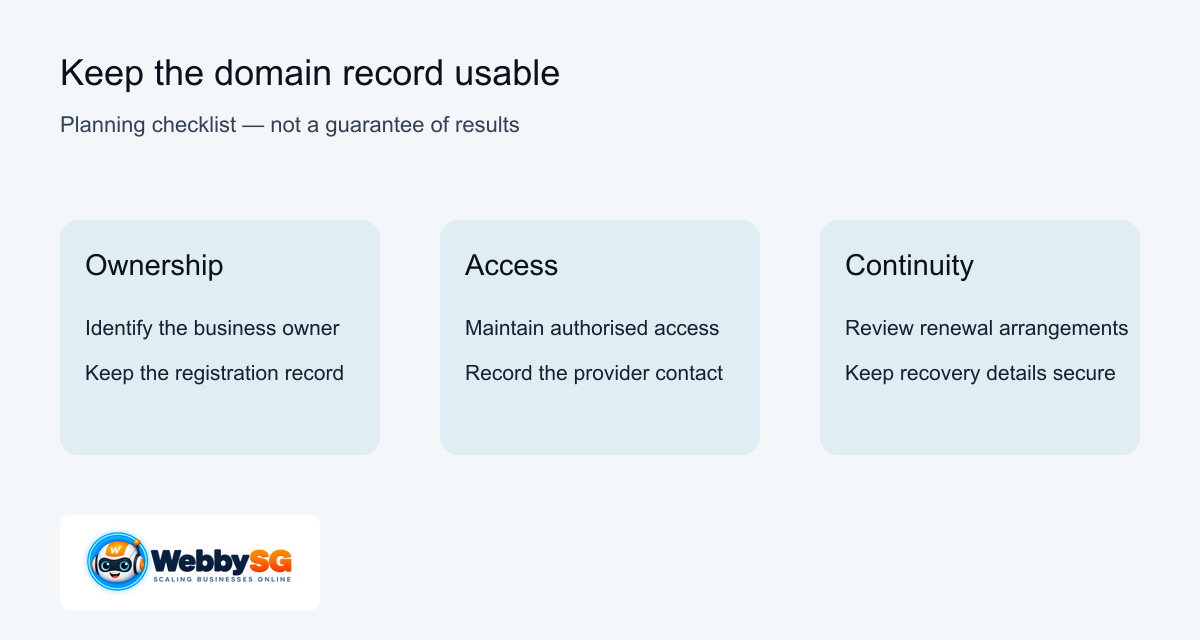
A domain is a core business asset. If it expires or becomes inaccessible, the website and domain-based email may stop working. Registrar access should therefore be treated like banking or finance-system access, not like a small design detail.
- Set the business or intended legal owner as registrant.
- Use a shared, monitored recovery email rather than a personal address.
- Store the registrar, DNS and recovery details in the company password manager.
- Record who may approve DNS changes and registrar transfers.
- Keep renewal reminders in more than one calendar.
- Review contact details when staff, suppliers or company information changes.
The same ownership principle should continue into the build. Webby SG’s WordPress development setup hands the domain, hosting and content over in the client’s name rather than retaining control inside an agency login.
When not to register the domain yet
Pause before payment if any of these points are unresolved:
- The brand name is still changing. Registering several uncertain names creates clutter and does not settle the naming decision.
- The intended owner is disputed. Decide whether the registrant is a founder, company, holding entity or another party first.
- The extension does not match the registrant. Check SGNIC’s current eligibility rules rather than assuming every .sg category is open to everyone.
- A similar brand already operates in the same market. Availability alone does not remove trademark or passing-off risk.
- The checkout profile belongs to a supplier. Ask for a business-controlled login or a documented handover process before proceeding.
What to do after registration
- Confirm VerifiedID@SG status. Do not assume payment completed the verification step.
- Connect DNS records. Add only the records required by the website, email and other authorised services.
- Enable HTTPS. The hosting platform or certificate provider should issue and renew the certificate correctly.
- Test website and email. Check both the main domain and any preferred www version, plus sending and receiving for business email.
- Document the setup. Record the registrar, renewal date, registrant, administrative contact, DNS provider and recovery method.
- Plan the website. If the domain is for a new site, define the pages and platform before development begins. Webby SG’s web development service covers corporate, ecommerce and custom builds.
Common .sg domain registration mistakes
- Registering the domain in a developer’s or employee’s name.
- Ignoring the VerifiedID@SG notice after payment.
- Using an email address that will disappear when a staff member leaves.
- Comparing only the first-year price and not the renewal arrangement.
- Changing nameservers without recording the existing DNS records.
- Assuming domain registration includes hosting, a website or business email.
- Waiting for the final renewal warning before checking payment and contact details.
Frequently asked questions
Can I register a .sg domain myself?
Yes. You register through an SGNIC-accredited registrar rather than directly with SGNIC. You will need accurate registrant and administrative contact details. New .sg registrations also require the administrative contact to complete VerifiedID@SG using Singpass or Corppass, subject to SGNIC rules.
What is the difference between .sg and .com.sg?
.sg is the broad Singapore country-code extension. SGNIC states that all persons may apply, although foreign applicants need an authorised local administrative contact. .com.sg is intended for commercial entities registered, or being registered, with an eligible Singapore authority or professional body. Check the current category rules before applying.
How long can I register a .sg domain for?
SGNIC currently lists one-year, two-year and three-year options for new registrations. Registrar products and renewal arrangements can differ, so check both the initial term and the ongoing renewal settings before payment. Keep the expiry date in a shared company calendar rather than one employee’s personal calendar.
What happens if VerifiedID@SG is not completed?
SGNIC says a newly registered .sg domain can be suspended if the administrative contact does not complete verification within the stated grace period. A suspended domain can affect the website and email. Follow the registrar and SGNIC instructions promptly, then confirm the WHOIS status shows the verification as complete.
Should my web developer own my domain?
No. A developer or agency may help with registration and DNS, but the registrant should be your business or the intended legal owner. Keep the registrar login, recovery email and payment method under company control. This makes renewals, transfers and future supplier changes much safer.
Domain SG registration: the practical summary
Choose the extension that fits the registrant, check the name with SGNIC WHOIS, buy through an accredited registrar and keep the registration in the intended owner’s name. Complete VerifiedID@SG promptly, then document DNS, email, recovery and renewal access. A clean ownership setup now prevents the most disruptive domain problems later.